




Half George w/Steve Pratt: Embracing The Weird
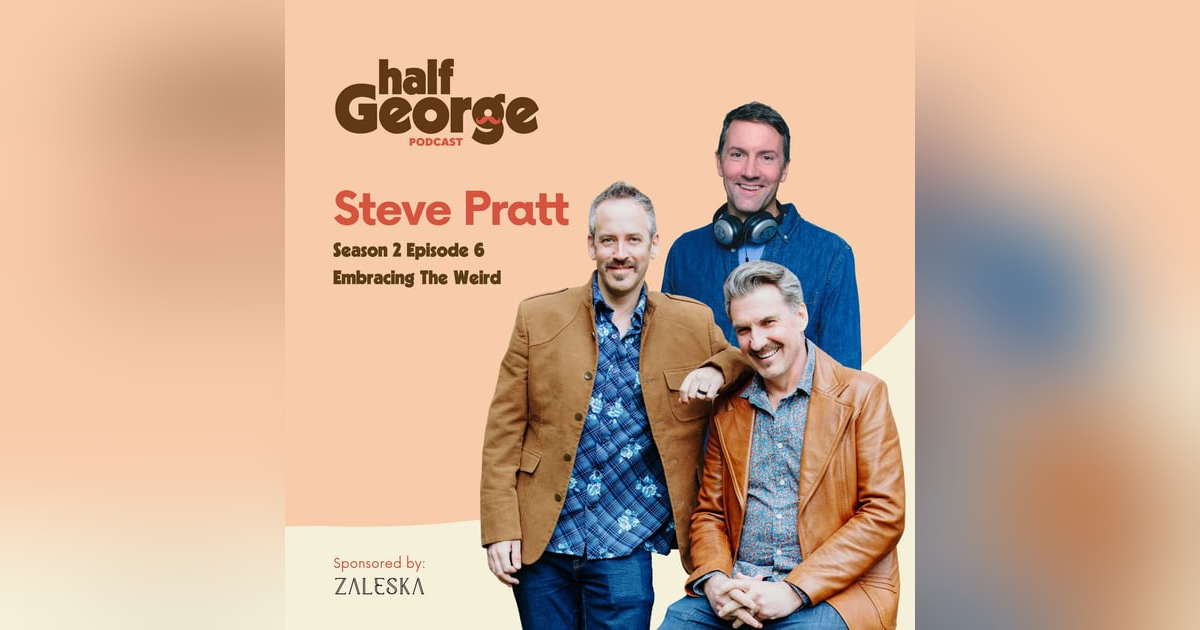





What began as an April Fools’ idea has become something much more meaningful.
Half George returns as a space for men to move into honest, open conversations about midlife alongside the stories we’ve been hearing from our guests on Half Betty.
Co-hosts Chris Rathborne and Kyle Gruen are joined by their first guest, Steve Pratt - writer, entrepreneur, and self-described “weird, kind, creative, enthusiast, experimenter.”
At 50, Steve found himself in a strange and profound shift - leaving the company he built, becoming an empty nester, and questioning long-held definitions of success and identity. Instead of rushing to redefine and make sense of it all, he chose to experiment. Literally.
Through his Midlife Field Guide, Steve approaches this mid-chapter as a series of real-life experiments - letting go of old metrics and beliefs and exploring what it means to live with more presence, curiosity, and intention.
This conversation is thoughtful, funny, and very honest - touching on identity, purpose, connection, and the evolving nature of work and life in the midlife chapter.
A reminder that this time isn’t about having it all figured out, it’s about staying open, staying curious, and, sometimes, embracing the weird.
Bio, Steve Pratt
Steve Pratt is our first Half George guest after our initial Half George episode in 2024 with co-hosts Chris Rathborne and Kyle Gruen. Steve is a midlife explorer navigating what this chapter of life has to offer with curiosity, courage, and a wicked sense of humour. Quirky, candid, and endlessly inventive, he has spent his career helping others find their voice and telling stories that matter.
He is the author of Earn It: Unconventional Strategies for Brave Marketers and the founder of The Creativity Business, a hub for helping companies craft content, marketing, and messaging that actually earns attention. He’s also writing the Midlife Field Guide, a Substack project in which he and his friend Geoff experiment with their own lives in public, trying to decode midlife, one adventure at a time.
Steve co-founded Pacific Content, the world’s first branded podcast agency, which he grew from the ground up in 2014 to work with global brands like Ford, Audible, BMW, Shopify, Adobe, and more - eventually being acquired by Rogers Communications in 2019. Before that, he ran a digital audio innovation lab at the CBC, launched one of the first legal music podcasts in the world, and built a highly engaged community for CBC Radio 3.
He lives in Vancouver with his wife, Debbie, and their three kids, Cedar, Dawson, and Charlotte. Always experimenting, always learning, Steve describes himself with his five words, simply as: Weird. Creative. Kind. Enthusiast. Experimenter.
The Midlife Field Guide with Geoff Siskind
Bio, Chris Rathborne
Chris Rathborne has spent 25+ years in promotional marketing and branded merchandise, building and nurturing relationships, shaping programs, and delivering results for brands including 7-Eleven, A&W Restaurants, Pacific Salmon Foundation, Pepsico, Indigenous Health and more. At BAMKO, he helps clients turn ideas into meaningful branding experiences. Chris is also the co-host of Half George, where he explores midlife with honesty, curiosity, and humour. A sports lover, Vancouver history nerd, music and pop culture enthusiast and lifelong family man, he lives in New Westminster with his wife Andrea and their daughters Sophie and Bridget.
Bio, Kyle Gruen
Kyle Gruen is a product management executive with 15+ years of experience scaling products across startups and growth-stage companies. He blends strategy, data, and operational insight to create solutions that work and more importantly, last. Kyle co-hosts Half George, sharing thoughtful, systems-oriented reflections on midlife, ambition, and life’s unexpected turns. He lives in Vancouver with his wife Krista and their twin sons, Weston and Foster.
References
Sponsor Information
Zaleska size-inclusive jewelry
Use the code HALFBETTY and receive 20% off your first purchase
Connect with us
Website link here
Instagram link here
LinkedIn link here
Facebook link here
Leave a voicemail for us
https://www.halfbetty.com/voicemail/
Half George
Guest: Steve Pratt
Hosts: Chris Rathborne & Kyle Gruen
Founder/Host/Producer: Andrea Rathborne
Producer/Co-Host: Krista Gruen
Editors: Andrea Rathborne & Krista Gruen
Audio Engineer: Ryan Clarke
Episode sponsors: Zaleska size-inclusive jewelry
Half George 2026
Andrea: [00:00:00] Krista and I are thrilled to welcome you to a very special episode of Half George.
What started last year is a playful April Fool's idea. Let's make a podcast for men in midlife. Inspired by George Burns quickly became something much bigger. We realized this wasn't a joke. Midlife men deserve a space to share their stories, explore what's next, and know that they're not alone. Just as we've been creating that very space for women through Half Betty.
So we asked Chris Rathborne and Kyle Gruen to step in as co-hosts. Chris quick-witted, unfiltered and full of laugh out loud honesty. Kyle, thoughtful, curious, and ready to take the conversation anywhere it needs to go, together they brought the first Half George episode to life and it is amongst our most listened to conversations to date.
This year we're raising the stakes. Chris and Kyle are back and for the first time they have a guest, Steve Pratt. Steve is a writer, entrepreneur, and the creator of the Midlife Field Guide, which he calls a "Living Experiment". This [00:01:00] conversation is honest, funny, and a little bit unexpected. It's about midlife, but really it's about being human, figuring things out as you go, and trying something new along the way.
And if you've ever asked yourself what comes next, you're in exactly the right place.
This is Half George.
Kyle: Alright, welcome to Half George. I guess we can say this is season two. I'm Chris Rathborne and I'm the co -host of, Half George.
I'm Kyle Gruen, the other co-host of Half George. Happy to start off our second episode.
Chris: Absolutely, it feels like it was just yesterday, but it was a year ago. Anyways, it was a great episode. I'm happy to be back. And, we've got, Steve Pratt with us today. Steve,met, My wife, Andrea, through LinkedIn, um, I think that she'd seen something about his book, Earn It, and, they had some shared interest, and here we are today, so, welcome, Steve,
Steve: Thanks so much. I'm excited to be on a podcast where season two is the second episode. Like, this is very rare. You know, it's like one episode a year. That's our season. [00:02:00] This is the best.
Kyle: It is cool. We're just happy they asked us to come back for a second one, so
Steve: been renewed. Yeah, that's great.
Can I tell you how excited I am for this? there's not very many podcasts to talk about midlife stuff, especially for guys like this. And to have a special episode of Half George, in the Half Betty universe, I'm honored to be here.
it's funny that when you talk about reaching out to Andrea, um, it was because of Half Betty that I had started this midlife, field guide on Substack.
and I used to have a podcasting company and I know that company Jar Audio that, was kind of the impetus for Half Betty that, Andrea won the prize to be able to make the show.
Um, and I saw all the stuff that Andrea was posting about it, and I'm like, I think we need to talk about what your midlife project is, because we have really interesting midlife projects going at the same time. And, yeah, it was such a wonderful connection to meet somebody else who is, like, publicly exploring all of this stuff.
Chris: Great timing. I mean, I'd like to get into that. Cause that's, the thing that most intrigues me is that project you're working on? And I've heard [00:03:00] a little bit about it, but, we would both love to hear your five words, that reflect you and sort of guide your life.
Steve: this is a hard thing, uh, but a good starting task to give to guests to think about as a conversation starter, so,
Chris: hard,
Steve: yeah, so, for people who are listening, there's a guest, prep form to be filled out in a super pro and, and detailed on the stuff.
And one of the things is, what are your five words? And so I got stuck thinking like, what are my five words for a while? And then I submitted it and then, um, I probably forgot my five words and had to ask to be reminded what my own words were before the episode. But the words are, uh, weird, kind, creative, enthusiast, and experimenter.
So. There you go. Those are the five words. Carefully curated.
Chris: I, I like the first one. I mean, that one stands out to me. So why, what about you is weird? Why do you feel weird? Or is it a feeling at all? Or is it just a word that kind of best describes [00:04:00] your personality?
Steve: a bunch of different stuff. So I would say one, I think I've never fully fit into like what the box that people are supposed to fit into and I've kind of pushed at it and tried to figure out my own path. Um, and whether that is like ending up in the media or Being a storyteller or having a podcasting company or whatever it is.
It's always been a little bit, um, hard to describe what I do because it's not a normal career path. Um, I also love weird things. Like I, I get really excited by things that are weird or unconventional. And, you know, it's almost like one of my secret strategies. When I'm doing, you know, a piece of content or working with a client on marketing or something like that is to find the weird stuff and amplify it, or just to double down on weird things, because that's what we all pay attention to and remember.[00:05:00]
And sometimes I need to kind of remind myself to double down on my weird or own it a little bit more exciting. That's what I'm most comfortable in my own skin.
Chris: absolutely. Is it something you've always felt growing up?
Steve: Yeah, when I think about the stuff that I liked a lot as a kid, it was, I mean, I know that things like the Farside, the cartoon, the Gary Larson thing was,
Chris: I love that, I love that cartoon.
Steve: But I was just like, this is exactly me, this sense of humor and this approach to seeing life this way, like those sorts of things, a hundred percent me.
And I gravitated a lot towards comedy and creative writing and things like that pretty early. And I think it was always this push against. What the things are that I was excited to do or where I, was passionate about versus what the normal career path was or what you should be doing or what other people said that, would be a smarter, safer path to be doing maybe.
Kyle: I really like that. I feel like it's one of the perks of midlife too, is I don't [00:06:00] think I started off that way. Um, I felt like I really had to fit in and I, I spent a lot of time and effort going to university right away and figuring out what my path would be after university. And I feel like now.
Got a lot more comfort to play in the space that you're talking about, like the weird resonates. It really does. I feel like you nailed it when you said that it's what people remember. Things that are different, things that are unique. And when it comes to marketing, it's the best place to start is your differentiation.
So, um, yeah, embrace the weird.
Steve: it's funny for a brief period after my, podcasting company, I had a company with two other people called the department of differentiation. And that was what we did we had this weird kind of like secret. government department slash cult kind of website. And our job is to come in and figure out what's the stuff that makes you weird or different than everybody else and to highlight that.
And it was, it was really fun. and I think in a way everybody has it and most people kind of bury it, um, or taught to minimize [00:07:00] it rather than celebrate it. But today I think it's the stuff that makes you the most human. Is talking about the stuff that makes you weird, like, I don't really want to blend in or be average or, or normal in most of the things in my life.
Kyle: Yeah, weird. Weird is more interesting.
Chris: Weird is more interesting.
Kyle: creates stories that are memorable. So,
Chris: you, did you play sports? Did you play instruments? did you read a lot? what would be something that really kind of shaped you, uh, in your youth
Steve: Um, I did play a lot of sports, and I did play a little bit of music, but not really. Most of the stuff for me ended up being comedy, to be honest, like comedy and storytelling. Um, most school assignments, I found a way to do something that was weird or funny,
And I remember changing schools in high school and this teacher pushed me to go do public speaking and debating. And it was terrifying, but it was also one of the best things I ever did because I feel like it let me figure out what my [00:08:00] voice was. And again, to not necessarily be a, uh, normal speaker or debater like i went to like a public speaking competition, which sounds like the dumbest, like I'm, I'm oversharing already here.
I don't even know you guys. I'm already embarrassing myself, but I went to a public speaking competition and it was in England and I didn't know what I was doing at all, but all these other people were talking about these really serious topics like, how are we going to end world hunger and figuring out how Ireland finds peace and things like that and I got up and did a story about airplane food and why do we even need instructions on how to use seatbelts on airplanes and things and it was almost like stand up at this thing and I did not win the public speaking thing but they gave me the most interesting personality and I was like, okay, that's Pay attention to that, that's my, win I may not be the most thoughtful thinker on world affairs, but I can entertain people, maybe, so, yeah.
Chris: that's so interesting. I've always, I've always admired a personality like that.
Weird is [00:09:00] good. I think weird is good.
Steve: Okay, so how are you both weird now, or what's the weirdness you're embracing at midlife now?
Chris: a great question. Uh, Kyle, why don't you go first? I've got to think about that for a second.
Kyle: Yeah, absolutely. Um, I think that's a great question. I see it a lot in my kids and how I'm raising my kids, um, because I've got twin boys and they're 10 years old, so they're really coming into their personalities and we embrace the weird, crazy, fun, adventurous kind of life.
We're really into music and art and creativity, and their mom, Krista is super creative. and I've always tried to flex my business side in combination with creativity. so with them, we really encourage them to get outta their shells. And one of our twins is, very comfortable in his skin and the other one's a little bit more shy and a little bit more anxious in how he deals with the world.
And so it's been really cool. I think it's probably the biggest. The piece for me is to see one that gets [00:10:00] out there and really doesn't care what other people think. we call him our honey badger. He'll dive into any situation and he doesn't give a, so, it's pretty cool to see him operate and then see Weston who cares more about what people think and he cares, about being the best at everything right away and really, really gets concerned if he can't do stuff perfect.
Um, and see them both play. And I think that it'll be a lifelong quest for us to help Weston break out of his shell and embrace being himself and being cool with it, if not everyone is the same. And it'll be interesting to see how Foster navigates, 'cause he's already there and he's, he's already like, it's cool.
I like what I like and I'm down with it. So, um, it, it impacts every day with those kids for sure.
Steve: so interesting because when you're describing that, it's like I can relate to both of those. Um, and I feel like I oscillate back and forth between those, even though I want to be more like foster. I find myself like being like, Oh, I'm probably in the other mentality and reminding myself. [00:11:00] Stop caring what everybody thinks and you don't have to be successful at everything.
Like, who are you doing it for? Especially at this age, you're kind of like, okay, We're here. The clock is kind of ticking, you know, like go do the stuff you want to do and who cares. Uh, so I love that he's got that early.
Kyle: Yeah. And you know what, maybe it's not mutually exclusive where some of the weirdest people I know are actually introverts.
Chris: Yeah,
Kyle: You know, like it's not until you get to know them that you find out how eclectic they are and maybe it's more one-on-one. So you don't have to be out there and weird, like there's all kinds of things that you, it's just identifying who you are and being comfortable with who you are and figuring how to share it with the world.
Yeah.
Chris: some would say introverts are weird and uh, I probably don't think of myself as an introvert, but I think sometimes I am and I don't know what weird things I do or think about. My wife thinks I'm weird because I'm constantly thinking about
Plumbing issues and watching plumbing videos and I don't know if that's weird or [00:12:00] just normal. I mean, I live in an old house. Things happen and I'm constantly, you know, worried about this and that.
you on plumbing talk? Okay
I'm not on Plumbing Talk, but, I don't know, might have to edit this part out, but I'm not on Plumbing Talk, but if that's a podcast, I might need to be on it, but, uh, no, I, I, I get great joy in watching people unclog drains
Steve: just gonna say I think that is weird and I love it Getting great joy out of watching people unclog pipes. You win you win. Yeah
Chris: you know, I know my wife will get a kick out of this when she hears this, but that's okay.
Steve: Yeah,
Kyle: satisfying about an unclogged pipe.
Chris: So a couple of things I want to talk about, and one is, I want to hear more about this book you wrote, Earn It. that's the name of the book. And, I would love to know about that and when you wrote that book and kind of what it's all about.
Steve: yeah, so I, I had this podcasting company, uh, that started in 2014 called Pacific Content, and it was a very weird company when we started it. Um, it was kind of before podcasts were a big thing, and even [00:13:00] in the world of podcasting, it was quite strange because we didn't, make original podcasts for ourselves.
We helped other companies learn to think and act like media companies and make real shows that other people would voluntarily want to listen to on an ongoing basis from a brand, which is a fairly tall order. Um,
Kyle: And pretty ahead of the curve back in 20 14.
Steve: so it was really weird. Um, and a lot of people thought we were nuts To make this company. But most of us had worked in the media for a long time. And so we, I think, understood how to tell good stories and how to make good shows and how to think about putting the audience first and what would make something that's really compelling. And it was like a Venn diagram between, what the marketing goals were.
Or, what the business outcome you're looking for is, and what an audience would genuinely value and want to spend time with voluntarily. And, strategy -wise, if we could find the overlap [00:14:00] between those two things, that's where our podcast business lived. And, So we pushed making these shows that, were kind of imbued with a lot of creative bravery, which is the idea that, like, as a marketer, you're gonna have to make a real show.
Like, you can't make an infomercial, and you have to make something that is from you, but that isn't really about you. And that's the secret to making something that people are going to want to spend time with, because no one wants to... Download a half hour of, talking about your products and services or how smart you are, your customer case studies or whatever over and over again.
So we did that for a number of years and worked with a lot of different clients and built out, a pretty good set of tools and strategies and ways to think about doing this stuff. And when I left the podcasting company in 2022, I was thinking about how much I would like to do another big creative project and something that I wasn't familiar with and that I'm an English literature grad, [00:15:00] uh, I'd always wanted to write a book and I was like, this might be the only window I have in my life to write a book.
And I started looking around at all the different ways to explore a book and talk to people. And it turned out that there is this book. Publishing company that has a walk from my house called Page Two Books And they're one of the best Publishing companies on the planet for exactly this type of thing.
They're called a hybrid publisher Which is not a traditional publisher and not self -publishing. They're kind of in the middle And their job is to kind of help people who have Expertise or experiences in a certain way, transform it into a really great book, and then figure out how to, use the book to do other things that you want to do in your life, whether it's, you know, some authors are speakers or consultants or trainers or, you know, whatever it is that you're kind of thinking about that whole ecosystem for a book and i was like this is like our podcasting company [00:16:00] but for books is that they're exactly the same thing and so i was i just hit it off instantly with one of the Co CEOs Jesse Finkelstein and decided to share all the stuff that we had learned about how to The title is Earn It.
It's about how to earn attention. Uh, is that so many marketers buy it or steal it or interrupt it or grab it or capture it. Like all these fairly aggressive, selfish things that it's like, no, it's very much like a relationship. You have to actually earn it by doing hard work and building trust and relationships and consistently providing value over time.
and the book kind of had to do all the things that it talked about. So it's, I hope, a bit of an unusual book in the way it's formatted and designed a bit as well. Um, and so yeah, that came out a year and a half ago, and it was one of the most satisfying creative projects I've ever been part of.
It was just a real treat to work on something really big and have it come out [00:17:00] with a great group of collaborators in an entirely new space that I haven't worked in before.
Chris: so, with this book now, are done promoting it? I mean, if it came out a year and a half ago, has it taken off? where has it really gotten legs?
Steve: it's interesting, it was a huge burst for about seven or eight months of just lots and lots of podcast interviews and speaking and consulting gigs and all sorts of stuff that showed up I don't think I could have imagined the impact it had on my life.
Like I was like speaking at conferences in Copenhagen and Athens and
Chris: Oh, wow.
Steve: New York and things like that. I was like, this is ridiculous. Um, it definitely has toned down since then, but I still semi -regularly end up getting asked to do a podcast about it or something like that. I think that's kind of the neat thing about a book is that it does have quite...
quite a long lifespan if it's good and people will continually discover it if you [00:18:00] keep marketing it. And,
Chris: Absolutely.
Steve: one of the examples in the book, is a guy named Michael Bungay -Stanier who wrote this book called The Coaching Habit. Uh, it's a, huge best -selling book. And, basically, it tells the story, like, he had to market it for two solid years and that's when it took off, it kind of hit the zeitgeist After really committing to saying yes and doing it for a long time.
And now it's 10 years in and has sold millions of copies. And it's like the defining book in that category. Like he owns the category of coaching.
Chris: Unbelievable.
Steve: so it's funny. I have had a hard time maintaining my own enthusiasm for the book for that long. Um, but, the chance to talk about it with You both here, it's like, I'm always happy to talk about it, and it always seems to generate some new readers who reach out as long as it's still relevant and creating value, I hope it kind of keeps going.
Chris: So you're in your midlife now, I know that. You've got some kids. You've got young [00:19:00] kids. Young kids? Older kids?
Steve: Uh, they're kind of adults, this is one of my weird midlife things, so I should back up to before the book. I think kind of my midlife -y panic attack or whatever it is, happened in 2022. so I turned 50 and I walked away from my podcasting company and I didn't have a career identity anymore.
Uh, and then my youngest kids graduated high school, and went off to university the following, um, Fall So I kind of lost my parenting identity and my career identity and my feeling that I was young all at the same time and I was like, oh, wow, I'm not really sure who I am anymore.
I should probably try and spend some time figuring it out and whatever it is four years in now still not there, you know made some progress still not there.
Chris: Well, I can certainly relate on that [00:20:00] moment when your last child leaves and, like you say, your parenting persona kind of leaves. Um, and it takes a while to figure that out and whether you're working a full -time job or not, it just completely changes everything about your day -to -day life.
And, yeah, having a career go the other way as well would be, some major midlife changes.
Steve: funny because both of those things are pretty big parts of your identity, right? Like, I mean, your career is something you build over decades. But, man, like the parenting piece for me, it was like, just so central to who I, would say I am. Uh, and I still am a parent, obviously, but it's just that piece that they're independent and living their own lives and not in your house.
Uh, you know, or even when they are back in the house, they're full, adults. Um, and I guess that phase of parenting is done and it's never coming back.
And, um,
Chris: No, it's never coming back and you kind of have to mourn it and [00:21:00] yeah, it's been a year and a half for me and I'm probably still mourning it. It's better, but it's hard. it's really hard. And, sometimes other things just don't make up for it.
Steve: I agree.
Kyle: was a big piece when we talked a year ago.
Chris: Yeah, it was.
Kyle: through that change for sure.
Chris: Yeah, it was very fresh, but, it does get better. And, Life has to move on It's just not the same and it's, definitely something you don't prepare for and I know Kyle, you'll be there one day.
And again, we talked about this a year ago, You just have to dive into it and, and, uh, Just time like anything kind of eases it.
Steve: How else have you managed it? what's changed in a year for you? Do you
Chris: Me personally just time and, knowing, I have two daughters that are both over at UVic and I think you know, my oldest has been there for five years. So it's it's when the last one leaves and it's just getting used to that. Um, just knowing that she's happy and settled and she's okay.
You know, she's, she's in the world and she's okay. but it has taken probably a good year of her getting into second year and finding new friends and [00:22:00] just getting into a rhythm of her life where she doesn't, need you as much anymore and you don't need to be there as much anymore, but, um, yeah, it's just time.
I think that's all it is. And you know, communication is never a problem with, with my kids. It's just not seeing them as much as you did for the first.
18 years of their lives.
Steve: what the thing that's been the biggest thing for me to kind of wrestle with is, um, Just the disparity between how much time I would like to spend with them versus how much they would like to spend with me that it's kind of like it, you know, like when they're younger, they want to spend all their time with you.
And I, you know, this sounds like I'm like reinventing cats in the cradle or something like that, but it's, like, yeah, you gotta really embrace it when they do have time for you and want to spend it with you.
Chris: Yeah. I mean, when your kids leave, that is the hardest part of midlife. And if you're fortunate to have kids it's the hardest part.
I mean, jobs, all that stuff, it doesn't matter. It's, it's getting used to not having your kids around. And, yeah, like you say, and [00:23:00] not having all that time with them.
Steve: Savour every second of it, Kyle!
Kyle: Right. I was gonna say that, that's my, takeaway here for sure. And it is such a big part of my, focus and my persona, like who I am right now. like, I think when they, do move on, I'll probably look for a way to refine myself and refine purpose and I'm seeing the earn it book right behind you, so that, must've been a good exercise to actually help you focus on something else and help you get your thoughts out in the world and give you some purpose.
Steve: Yeah, it was very satisfying to do it, and unlike a, job, it's a project, and then the project is over, uh, and then you're kind of like, okay, well now what, um, and so I feel like I'm in this weird project mindset, and then there's some tension in there around not just having a North Star, To just keep moving towards infinitely, but kind of like what's the thing I want to do now, or the thing that has my attention or [00:24:00] curiosity now, and I don't know, I'm not going to lie, I feel like there's periods where there's just gaps where I'm just looking for it, and you know, when it arrives, it's the best.
Um, but when it's not there, you're kind of like. What am I doing? My kids are gone. Who am I? Who am I without these things? It's, uh, it's interesting.
Kyle: Yeah.
Chris: hopefully, your friends and family and again, you can't ever make assumptions, but I never want to look back on my life and think that my career defined me and yeah, we're still in it and there's days I, I'd love to be retired and just be able to do my own thing and I don't want to get too far off topic, but you know, yeah, it's at the end of the day, we all still have to make money.
So did you write this book to make money or was it just more to write the book because you really wanted to write the book?
Steve: It was mostly because I really wanted to write the book. And I feel like I was not the most strategic about it. But, at the same time, it's been, very successful. and not just in [00:25:00] the book. I feel like it's weird to say that. I don't mean that in a bizarre way, but I just mean like, it's been, it's been surprising to me the impact that a book has had about things that just show up that you aren't expecting.
like in the first week of it being published, I ended up with an amazing consulting contract from just out of nowhere. Um, you know, or some of these speaking things that turn into consulting things or whatever. So it is a wonderful way. to think about that like and I think if I was going to do it again I would just be a lot more strategic around what you want to get out of it and design for that a little bit more um I think almost all the authors at Page Two are more strategic about that than I am because that's what they're really good at is helping people do it and I was like I'm not sure I'm ready for it yet but I think uh yeah it's definitely a very
a good path to go down if you want to do that to think about how can the book be something wonderful on its own and be a catalyst for other parts of a business or [00:26:00] career that you want to build well
Kyle: It kind of becomes a personal marketing tool I guess, like you can build your whole brand around it. I've known a couple other people around, around same age that have, have got ventured into writing and, if it lands, it can become pretty central to your brand.
Steve: it's interesting there's not really many things that require that level or depth of thinking in in your life anymore that you get to actually say like I put out something that's you know 250 or 300 pages of really deep Thinking or digging deep into a topic to try and be helpful to other people.
Um, so when you say like as a marketing piece, there is something to the fact that you've put so much thinking and effort into it that hopefully there's, something really valuable in there for other people in there. I think, like most good marketing, if it's good, the best way people will find out about it as a word of mouth is someone will read it and tell other people about it and it ends up being good.
Going and going and going. So, um, you know, hopefully it keeps [00:27:00] going.
Kyle: Yeah.
Chris: so. I hope so. I mean, I have to ask we're in the world of, AI now. Where do you see? It's kind of a loaded question. Uh, where do you see AI kind of affecting what you do and, uh, your business, whether it's writing books or, the marketing, business that you're in
Steve: Well, it's so interesting. I, I, I spend a lot of time thinking and playing around with AI, and I'm also wary of it. Um, you know, like, I don't know, how fresh this will be when, when this comes out. But, there's this thing with Anthropic. and the Pentagon in the last few weeks around, that they were not going to let their ethical guardrails go down around how AI was used.
Um, and I feel like I'm trying to figure out what my own personal guardrails are for AI usage around where it's really helpful and valuable to me and where I have guardrails. So it's like I'm preserving this because it's important to me. And right now I think that that is my, my actual writing and the ideas or the creative work that I do and that I use it.
as a really [00:28:00] good, you know, almost like editor or collaborator once I've got the ideas to hone things or help things. And then I'm also trying to think like, what are the parts of, life that I, know what my weak spots are and where can I get it to do a bunch of things that I don't want to do anymore.
Like I got added to this really amazing thing. A weird, WhatsApp group of all these AI kind of innovators all over the world, and I've only been in it for three weeks and I've learned so much from just kind of lurking in this AI group and it got me to be like, I, I, I built some, thing that I just take my bank statements and dump them in a folder once a month.
And it's going to do all my expenses and tracking and report back on everything. I don't have to do anything. And I'm like, Oh, this is amazing. And so the question is what happens to marketing or consulting or, those sorts of things. I think a whole bunch of stuff is going to [00:29:00] get automated by it.
But at the end of the day, I think there's something that is never going to get replaced, which is. connection like that people don't have emotional connections with With a I mean, maybe some people do have emotional connection with ai agents. I don't know that that's even more worrying
Kyle: starting to happen.
Steve: uh, but I think a brand that does not have A point of connection where you feel like, you know who they are or you know what they stand for That you feel like you can trust them or that If they end up being kind of too generic or if AI really is a prediction engine of what's the next most likely thing to come up for me, the thing that I'm most interested in is how do I continue to help people become the most unlikely thing or the most surprising or unpredictable thing that I think that that's an interesting human space to be in. And then also what are the stories or experiences that can never be replicated by AI, Hey, when I did this, this is the thing I learned. [00:30:00] And here's what you could apply from that. Or AI could never have a conversation like this with you guys.
Uh, it could never have a real life meetup to have an experience that you'll never forget. So I think my hunch is that there's going to be a real push away from some of the places that are going to get swamped from AI to how do we make things that are special and memorable and very human. And that might be.
A really interesting area of opportunity for, marketers and people in, general looking to where the
Chris: adapt. I mean, we've adapted to the Internet, which, I think about all the time we didn't have the Internet, 35 years ago. And it's hard to believe that we didn't have Google or we couldn't go on our phones and look something up like we. Didn't know it was coming and, yeah, I haven't really jumped on the AI train and I probably will, but I'm in the business where it's human connection.
I mean, it's phone calls and emails still in having someone write an email for you is great, but I still want to have it to be [00:31:00] my own voice. And I want, somebody to hear my voice and I want to see somebody in person and talk through things. AI will never do that.
Steve: had my first, AI agent phone call a few weeks ago and I picked it up and it was like, Hi, is this Steve? And I was like, yes. Um, hi, it's Dana. I found you on LinkedIn. And I'm like, okay. And then there's this weird pause and it was like, Okay. Do I understand correctly that you're looking for tailored men's shirts?
And I'm like, no, not at all. and it kept going and I'm like, is this an AI agent? Like, are you AI? And it was like, I'm Dana. And I'm just like, oh no. It was, really weird. Um, I was like, to your point, real humans, like, I know it's going to keep getting better, but I think we're going to start trusting.
When we see real people and talk to real people, and we're going to be wary of things where we can't tell anymore. I've seen some really interesting stuff, that this may be the beginning of the end of social media, which I would not be sad about at [00:32:00] all.
Chris: I would agree. I would, be happy about that. For sure.
Steve: if you can't, go on and you can't tell what's what,
Chris: What's the point?
Steve: yeah, exactly.
Chris: I don't...
Steve: yeah.
Kyle: It's just another way of mass creating content, and we already have a lot of ways to mass create content and the value of that content drops down to near nothing if it's not unique and interesting and differentiated and somewhat believable.
Steve: I think you just nailed it, Kyle, like, unique, interesting, differentiated. That will be the bar's gonna just get higher for what we're actually gonna be willing to spend our time and attention on. And so, in some ways, it's almost like this clarion call for creative people, like, make awesome stuff.
Like, stop painting by numbers and following formulas and make something really awesome that blows our minds. Because that's actually going to be the stuff that stands out and pops now. And I think we're all kind of dying to get away from the slop and the sameness.
Kyle: That's it. And so for a little context, I'm a technology product manager, and I'm right up on AI and I'm living in a world where [00:33:00] my job's changed a whole bunch in the past year and definitely in the last three months. Um, and I've gone fully back into learning mode. Um, I don't think that we're where it's gonna settle.
I think that everyone is in learning mode right now, and there's so much change every month that Chris, it's almost good to wait and see how the dust settles. That's one strategy. Um, I can tell you that keeping up on it all is insane and it impacts almost every industry. When I look at it, I'm working in health tech right now.
but it's definitely starting to impact that industry. there's a lot of other industries where it's already there. And if you look at the rate of change of. Claude or chat, GPT or any of the open AI products, they're using AI to release so fast that we can look at their release model is where I think the rest of, uh, industries are gonna follow, um, for better or for worse.
And there's a lot of learning there every week,
Steve: it's so funny, they're building themselves now, right? Like the new models are saying that they're mostly been designed by the previous models.
Kyle: 90%. Yep.
Steve: where there's human [00:34:00] oversight, but it's not fully being designed by them. so mid -life wise, Kyle, I'm so curious. Yes.
Kyle: Mm-hmm.
Steve: do you feel being a more experienced person in there compared to being someone who's just out of computer science school uh In this world do you feel like you're on top of it more than everybody else?
Or do you feel like you're behind it?
Kyle: Um, I, I think it.
Steve: don't know
Kyle: I think the nature of my role have to be very curious and flexible. Like I've seen technology change a lot in the past 15, 20 years. but this, rate of speed, has changed a lot in the past year and I feel like you always wanted to move fast and now I feel like stuff is starting to move faster than it ever has before.
But I still think that some of the core principles around how I do product management and what I've learned over the years and all that experience that we garner into midlife has value. And the gut feelings that I have are still there for a reason. Um, I think that where it changes, it lets people get up to speed quicker across the board.
So that means that I think For newer employees, there's a [00:35:00] risk that, they get replaced by AI agents that are already skilled enough to do the job. But I think if you embrace it, you can actually get up to speed and get past that pretty quickly. And I've always thought that, younger employees, when they come in, you never know how quick they're gonna catch up and learn.
Someone can go from an intro to an expert in a few years and be a 25-year-old coding engineering guru, um, that becomes a real leader at a really young age, or some people have a slower pace and still have huge contributions. I feel like now that pace is being forced to go a little bit faster across the board.
Steve: this group chat that i'm in there's a conversation around ai burnout almost where People are feeling that, because everything is going so fast, they feel like they have to do so much to stay up on everything, that they're not sleeping and that they're thinking about AI all the time and trying to get all these things to be doing things while they're sleeping and, you know, with their families and things like that.[00:36:00]
And then there's this balancing conversation around like, Hey, aren't we supposed to be using it To be more efficient so that we can have more time to do the things that are really important like family and friends and it's, you know, health and all those sorts of things right?
Kyle: Agents work 24 7 and you can put an agent to work all night long, and if you wake up in your first four hour sleep cycle and are thinking about it, you might wanna quickly check and see how it's going and make some adjustments. I could see that totally happening, but I don't know if our brains in midlife are set up for this.
I think it's a really valid question you asked around how we're adapting to this because, it takes a unique personality to stay open to it. There's probably like Chris saying, that you're waiting and not getting too into it, you probably will. that's really common at our age.
And
Chris: you. Please tell me that's common because I feel like I'm under pressure sometimes from other friends who are deep into their Claude and stuff.
Kyle: There, there's really adopters everywhere, right? Every, every technology. whether you're diving into crypto or whether you're diving into NFTs or all these things that have come and [00:37:00] landed somewhere, um, you don't always have to be the first one in to, to get the most value out of it.
Sometimes it's actually good to let things play out a little bit and just pay attention and then dive in.
Steve: It's interesting in the midlife front. I don't know how whether you guys feel this or not either but I've always felt like the young person. Even in my mind, you know, at work and hit me in the last. ...you know, several years being like... I'm the old guy in the office. Like, I'm actually old now. It just doesn't register with me.
But I feel it more and more. And it's funny, as you're saying, like, do we have the right mentality to handle these sorts of things?
Kyle: Yeah.
Steve: You know, I don't want to be like that thing where... You go in and everybody's like, you know, whatever the okay boomer is for us at this point is with technology or whatever.
Uh, I've never had that fear before of like being behind or forgotten or irrelevant because I can't keep up with things. I've always been so [00:38:00] interested to be at the edge of the innovation stuff I get really excited by new things and where there's a blank canvas that where the rules haven't been made yet.
that's where I'm most excited.
Kyle: that's it.
Steve: And I also find I don't want to not sleep because I have agents working on things while I'm sleeping. And I'm actually in this stage where I want balance and I'm still curious and excited. But I don't know whether that combination is going to be like, everybody else is willing to burn themselves to a crisp at this point.
I don't know.
Kyle: Yeah. Well, I think the boomer term it's funny my kids use that term all the time. Okay. Boomer. Um, it's part of, their generation for sure. But I think the real term and where it with pride is Xer and we've been through everything from no tech to high tech and everywhere in between.
And so I think there comes a bit of a resiliency there and an open mind to adapt, maybe even more so than people that have grown up with technology. Like we can do stuff with or without, and figure out a way to get stuff done and learn at each step. So,
Steve: that. Yeah.
Kyle: yeah. Yeah. Yeah.[00:39:00]
Chris: So Steve, was there an experience in your life, whether it was in your midlife in your in your teens that really shaped you to kind of where you are now?
Steve: Um, I mean, honestly, I feel like the biggest thing recently was that kind of the triple, like, turn 50, leave the podcasting company and then my kids, empty nest thing like that. I can't think of anything more that has impacted me more as an adult. I had a health thing when I was young where I got told there's like for two weeks that I might die within a year.
Um, that shaped me fairly strongly. I think it gave me almost the same version of what I'm getting at the midlife stuff. but they both been kind of the same lesson of being like, you may not be here forever. Like, what are you waiting for? go do the stuff you want to do and don't be apologetic about it.
And don't worry too much about what other people think, like, think about yourself on your deathbed and being like, what are the things that I'm gonna, deeply regret if I [00:40:00] don't start doing them right now. And it's weird that I had that thing when I was younger because I think it actually propelled me away from going to law school and led me into doing stuff in television and media, which, changed the course of everything in my life.
Um... And now it's leading me to, kind of re -evaluate a lot of things, and being like, why have I been doing all the things that I'm doing, and what do I actually want to do at this phase of life, and what's important, given that I am this old, and that my kids are adults, and all those things.
So you know, they're both, really big opportunities for pretty hard in the mirror, I guess.
Kyle: It's a good way to
Chris: Absolutely.
Kyle: a challenging situation and turn it into a positive. I think that, Any event, traumatic or not, gives you a chance to reflect and figure out what's important. So, I bet that that event had an impact on how you dealt with your kids leaving and trying to figure out where you're gonna be af after 50 as well. Yep.
Chris: So [00:41:00] that, sets us right into what I really want to talk about, and that's the Midlife Field Guide. Because I've been hearing about this, I've heard, um, not enough. So I really want you to tell us about the Midlife Fuel Guide and explain how that all works.
Kyle: ties nicely into your fifth key word, experimenter.
Steve: Yes, yeah, I feel like it's been a running theme in my life as I was saying, when something new is out there, I like playing around with it and figuring it out. and I have a friend in Toronto named Geoff Siskind and, we were talking a lot, over the last couple of years around what's going on in our lives and midlife and what we want to do and change.
And, it was very much that. It was like, oh, this is new and interesting, and we don't have all the answers yet. What would be a fun way to figure out some of these things that we keep talking about and don't know the answers to? And I kept reading books from experts saying do this, do that.
And a bunch of it was contradictory. some of it was very consistent, like you need to have friends and be out in [00:42:00] nature or whatever it is. Uh, um. But, certainly, there's varying degrees of, like, should I be taking all sorts of weird supplements to try and live until I'm 120?
forever stuff, right? Um, and so we're like, well, what if we just decided to make a thing where we did experiments on things that we were curious about as normal people, not like experts to just say, let's try out one of these things that we're curious about at this stage of life and see what happens.
And then that could be a new content project. And so we started this thing on, Substack, like an email newsletter called The Midlife Field Guide. and basically we just choose an experiment to do in our lives and set it out kind of like an experiment and document what happens and then share what we have as insight at the end of it.
I feel slightly, embarrassed for anybody who's listening to this. That sounds really impressive. [00:43:00] Uh, like some of the experiments are not like that. It's like I, like I grew my first ever beard as one of the experiments. Like I was 53. I'd never grown a beard. And I grew this hideous, you know, living in the woods beard, uh, for, for like nine months.
Uh, but it was great.
Chris: I think I actually met you when you were in the midst of that, or maybe the end of it. I don't know,
Steve: Yes. Yes. Yeah. Yeah. Uh.
Kyle: is, so I, I went. I went deep into the rabbit hole of the midlife, field guide, last night.
Steve: Okay.
Kyle: But I, I saw the title around the beard, but I didn't get a chance to read that one until today after lunch, about five minutes after I shaved my beard off.
Steve: Okay. So I saw the photo. So, so this is something people listening to do this. I got a research package from Andrea and Krista. It's amazing. And has photos of you guys and Kyle, it has your beard in three stages of like this wild beard. And then the half beard and
Kyle: Oh
Steve: Kyle and I are going to talk about beards.
Kyle: You, betcha. My, beard experiment was a COVID beard [00:44:00] experiment. I think a lot of people went down that path working from home for the first time and all that kind of stuff. when I read your post today brought back a lot of memories from that phase for sure.
Steve: why did you shave it? And why today?
Kyle: Yeah. So, uh. I started a new role, uh, just a week ago, and I already had it pretty short, and so it was kind of in that in-between phase and I think you probably know about it started to itch a little bit and it does all these things that new beards do. Um, and also, I'm pretty gray on the sides here.
I thought I'd looked better on camera with it a little bit shorter, so
Steve: I love it.
Kyle: yeah. What did you find from your experiment? what were the biggest takeaways?
Steve: Well, it was interesting, like, I would say, uh, one, it made me look much older. Like, everybody instantly, like, you look ten years older, and then when I shaved it, it's like, you look ten years younger.
Kyle: Yeah.
Steve: And it's like just a lot of grey and but, I hope this doesn't sound too weird, but I did feel like a bit more manly than I normally do [00:45:00] having this thing on my face.
And I feel like, um, like in different social situations, I had conversations with people that I would not have had conversations with because I had a beard. beard and potentially looked slightly more masculine than what I normally do. Um, it almost felt like I, going undercover as a real man for a period of time.
I was kind of like, oh, I hope no one finds out that I'm, still this like, you know, weird creative, guy who thinks he's 20 in his head still. Um, yeah, it was, it was pretty funny. it felt like I was cosplaying a man, which is kind of funny. Yeah. Uh,
Chris: what was the first thing you did? Was the beard the first thing you did, or was, was, uh, you've obviously done a few things.
Steve: I stopped drinking, uh, was the first thing I did, which is, you know, I think more and more people are doing it now, but it was still very polarizing for a lot of people in my life, and it was, uh, like, the actual [00:46:00] stopping drinking was easy. The, the social pressure of not drinking super hard, like, it was, much harder than I expected.
Um, yeah, there's, so much. Good non -alcoholic stuff of almost everything except red wine out there. Um, that it was just fairly seamless. and I started off thinking, I have friends who've had alcohol issues and said, if you're going to do something, you should really do it for four months.
That that's the magic time. Like, dry January is not enough. You actually start seeing big benefits after four months. And so okay, I'll do four months. And then when we started the field guide, I was like, you know what, I should make it a half year, like six months sounds like a better thing.
And then the six months went by and it, I did it for over a year. Um, and I've had a, drink on my birthday and I didn't really want to be on, I, we can talk about this later also, but like, I, I didn't really want to have a streak. [00:47:00] Uh, kind of like had some weird aversion to.
Streaks and measurements, things like that as well that I've been experimenting with, but the no booze thing been shockingly great after something that has just been conditioned into my life. since I was 18, uh, everywhere.
Chris: really is a big part of most people's lives and whether you have a problem with it or not, it's, a major social thing. And it's a big part of most people's lives. Yeah, it's feeling left out.
I haven't tried it before, but I can only imagine what the social implications are of, of not drinking with your friends on a weekend or at a party. Your
Steve: and I thought it was going to be like I was going to fall asleep and just be bored while everybody else was wasted. It's actually totally fine. Uh, I think it just makes everybody else feel weird that there's somebody who's not drinking around you. And so they're kind of like, when are you going to stop this?
When are you going to get back to drinking? And like, why does it matter to you? Um, but it's, there's something in there about it.
Chris: family was supportive, obviously.
Steve: Uh, I would [00:48:00] say my wife was very supportive. Uh, my parents are like, what are you doing? Why are you doing this? Uh, don't you want to have a drink on, Christmas or on vacation or, you know, whatever it is?
Um, but I've found that it's had this little contagious effect where a lot of people around me have lowered their drinking or cut back significantly while I've, been I've been doing it, uh, as well, but my wife was on board from day one. she had cut back on stuff prior to doing it.
But I think I was, the one who said I'm actually calling it zero for an extended period of time as an experiment. And, yeah, I guess the interesting thing was at the end of it, I could say like, oh, I slept better and yeah, all those sorts of things.
But in a weird way, once you stop it for an extended period of time and you get comfortable with it, There's this thing where you're just like, well, why would I go back to doing it? what's it adding to my life? And that's a harder question to answer, is like, why should I start doing it, again?
Which I think was an interesting place to come to, because I really wasn't expecting that at all. I was expecting to be [00:49:00] like, okay, great. This is good for my long -term health, but I, I miss it. I ended up not really missing it as much as I thought I would.
Chris: That's very interesting. I've thought about it. Maybe it's time to, maybe it's time to try the four month experiment.
Steve: There you go.
Kyle: I feel like I'm too sensitive to peer pressure at this point still. So I give in and I think, from a health standpoint, it's the right choice. It's probably one of the most impactful things you can do, especially at our age with, uh, liver impact and, honestly, the fog after a few drinks is more than it ever was when I was in my early forties and thirties.
So all that stuff starts to add up
Steve: weird. There's a whole, secret universe of non -alcoholic stuff out there. so I, I live, in Vancouver, in the main street area and there's this place a couple blocks from my house called the Welks. And in the back of the store, there's this whole non -alcoholic section, that I did not really know about.
They don't promote it. It's not there, but they have tons of stuff. And then one of my friends told me that there's a place on Commercial Drive, in East Vancouver, called Mocktails. [00:50:00] And it's a non -alcoholic liquor store. And the entire store is just non -alcoholic stuff.
And you go in and there's... essentially, non -alcoholic sommeliers and things that are in there that'll help you choose the stuff that you want, and, uh, yeah, it's been a really interesting peek into a whole world I didn't know existed.
Chris: Very, very, very interesting. So what's the current, experiment if you want to call it that.
Steve: I've been into this thing that has become a bit of a recurring theme, so I started, another really big one last August, I did a phone detox, where I... I took my phone out of my bedroom at night, which I thought would be nothing. It was actually really impactful. Uh, but I didn't use any social media, and I did not check news sites, and I didn't do, Wordle.
Uh, like, I broke a massive Wordle streak, for a month. And I came away from it being like, Oh, this is amazing how much better I feel being away from all [00:51:00] this stuff. But I noticed that all these different platforms did not like it that I wasn't using them and that there's these escalating strategies for trying to get me back using it again.
so like LinkedIn would send me these things being like, Hey, you know your thing just got a comment or like, hey, here's a post your friend made or your post got this many things last week. What are you posting this week? And then it started sending me actual content from LinkedIn in my inbox being like, here's five things that you didn't see on LinkedIn.
And I'm like, you're recreating LinkedIn in my inbox to try and get me to leave. they're all doing every trick in the book. To get us to spend as much time as humanly possible in their product because that's what's good for them, even though it's not actually good for us.
And so that was, a huge revelation for me to just actually have the time away from it and feel it. And then the next layer, and Kyle, I hope this [00:52:00] is not going to offend you saying this with your new job. Uh, but I wanted to go one layer further. I've been a bit of a nut around tracking a lot of my health stuff.
Uh, so I had an Apple watch for years and years. I got an Aura ring during the pandemic and I just, read this thing about the quantified self, like I was a long time ago and I'd like, Oh, that's interesting. And all these, cliches around measure what matters. I kind of bought into it, but then coming out of this phone thing and realizing I'm getting up every day and looking at my sleep score and it's shitty And I can't do anything about it.
And it'll tell me the same things. I'm like, I did that and it's still shitty and it's like every day I wake up and I look at this thing and my day starts with depression. I'll be like, Oh, I had a bad sleep.
Kyle: Mm-hmm.
Steve: Uh, and so I've kind of had this thing like, man, I wonder what it'd be like just to take all this stuff off for a month and see what happens.
Because I'm letting, [00:53:00] you know, Scoreboards designed by third parties determine how I feel about myself.
Kyle: Yep.
Steve: And a whole bunch of it was again, just like gamification of my life that other people have designed. And it's like, you know, have you closed your rings? why don't you stand up for two minutes or go walk around the block or whatever it is your device is telling you to do?
I'm like, Oh, this is really weird. That. I'm kind of being programmed. Um, Uh, Even if
Chris: the, you're the robot now.
Steve: Yeah, exactly, right? And I'm kind of like, well, I guess at least some of these are trying to make me healthier, like there can be good gamification, I guess, right? But it didn't always make me feel good, and I paid way too much attention to it, and so I stripped everything off, this is my third month, I'm not wearing a watch or ring or anything like that.
And I feel so much better. I feel like I'm just telling you embarrassing stories about myself, but part of this middle -aged [00:54:00] group of guys that go and ride bikes and then post about it on Strava afterwards, which is, and for people who aren't on Strava, it's like. Facebook for exercise, I guess. I don't know. It's like people track their runs and bikes and things like that.
Chris: yeah, I've heard of it.
Kyle: I'll add you on Strava later.
Steve: Okay, good. Uh, and so I'm, I'm in this group of guys called dad squad and we have these jerseys with skulls on them and stuff. And it's, it's ridiculous. but for years and years.
Every bike ride has been this thing that's been tracked and it's on a route and you know how fast you're going and people are going out and it's like, you know, you're kind of pushing yourself to do it and then it gets posted publicly and people like it or give you kudos or, whatever it is on Strava.
Kyle: Yeah.
Steve: And I went for my first bike ride with my wife with nothing, this weekend. It was really nice. She's like, let's go for a bike ride. And so I went out with no Strava, like [00:55:00] no anything. And we ended up just kind of cruising around and going down all these residential streets. And we were talking and ended up in some neighborhoods we hadn't been in.
And we were like looking at all these weird houses that looked like they'd been built in the 70s and 80s and talking about it. And I was like, Oh, I'm having fun riding a bike. And I'm not doing it for some other purpose. Like I'm not posting about it and I'm not, Tracking how fast I'm going or how far I'm going.
I'm not using my bike as a means to some other end or trying to be successful at riding a bike. I kind of just had a joyful time riding a bike for the first time since I was a kid and I was like Pay attention to this do more of this. Um So, I don't know if there's something in there for me around pay attention to the scoreboards that you pay attention to and who designed them and are they actually designed with the things that are making you happy or not i'm
Kyle: Yeah, I have to admit, I read those posts with a lot of interest and there is a bit of relevance to what I'm doing now. [00:56:00] and I, I think that's beauty product management is I get to learn from all experiences and I think it's super valid. there is so much out there right now for health.
it's a hot topic. There's a group of people that are proactive on this kind of stuff. And, and I think that, part of what works long term is probably something that doesn't include all that stuff. It's probably more something that's personalized to what you really need whatever phase of life you're at. And someone who's training for a triathlon uses Strava for a different reason than someone who just wants to make sure they log their last ski day and got some kudos from their friends.
And so yeah, there's a whole bunch different purposes for why people get motivated by these applications and hardware that goes along with them. And then we carry around these phones, so everyone's got Apple Health going and, 10,000 steps a day and all that kind of stuff. And I'm really excited to be trying to figure out what the next generation of that looks like.
And, I think to your point, it's not gonna look like it did the last 10 years. A whole bunch of different things, kind of talking to each other and creating [00:57:00] more complexity. It's gonna be something that hopefully, um, simplifies it for people.
Steve: I'm excited to see what you come up with um because it's interesting my kind of scoreboard challenge stuff The thing that made me flip out a bit and just decide to do it and take it all off was listening to a podcast, um, with this guy talking. And it was about the meaning of life. And I was like, oh, this sounds like a midlife thing that I'd be interested in.
But the first 20 minutes were all just about, his morning routine and how he gets up at 4 a .m. Because of some, thing that an Indian elder taught him called the Brahma Muhurta around an exact time for waking. And then there's a power hour in the gym, which he calls the most important room in his house
Kyle: Yeah.
Steve: And then there's like an hour of prayer. And then there's a high, off base prescription of creatine he takes. And then he's taking a huge amount of caffeine, but not for enjoyment, just for optimizing [00:58:00] productivity and creativity and stuff. I'm like, this is not a life
Like this is crazy. I kind of recognized how absurd that one was that it was like, yeah. there's all sorts of people peddling this stuff, and all sorts of people who are looking for answers, being like, well, that person sounds like they figured it out. I guess I should get up at 4 a .m.
and start doing all these things. I'm like, as soon as we start trying to cram everything in to try and be, successful at life, I almost feel like we lose the ability to live it and enjoy it in the moment. And that's one of those weird clichés, I think, is just, When we were talking earlier Kyle about your kids is like, yeah, be present in all this stuff with your kids.
If you're, chugging creatine, while your kids are, you know, I think we're missing out on a lot of stuff by trying to optimize everything, if that makes sense.
Chris: it's just too much now. It's just too much.
But yeah, it becomes a bit of an obsession and that's where I just can't relate. I'm not an obsessive person for Apple [00:59:00] watches and, marking all my bike rides somewhere. So, but. It's in
Steve: Do you have a scoreboard for unclogging pipes? Oh, okay.
Chris: In my, my head, I've, I know exactly how many times I've done that in my life and it's, it's, it's maybe that is obsessive. Yes. Thank you. Yeah. Thanks for
Steve: If not, there's an opportunity for business here.
Chris: I don't know. Yeah. My wife thinks I should be a plumber,
So maybe I should get into, plumbing, but yeah. So where do you see yourself in five years now? I mean, you're in your early fifties, but are you thinking of working until you're 75 or are you thinking about, something different?
Steve: I'm still in the process of figuring it out. And I think this is the interesting thing is like, I don't even seeing figure it out. Feels like the wrong thing. To say, because it feels like I'm trying to be, again, like, I'm fighting my own instincts to try and be, like, successful at midlife.
if that makes sense.
Chris: it's a lot of work.
Steve: Yeah, and I almost feel like it's maybe the wrong answer, is that it's not a problem to be solved. I feel like I'm [01:00:00] maybe over -obsessing? about it and that it's just having conversations like this and then paying attention to the stuff that you actually want to do or, I feel like in some ways it's almost like, like a period of questioning around, why am I doing the things that I'm doing and what's really important versus, adding in a whole bunch of new behaviors to optimize something is I feel like maybe my life is going to get smaller and simpler.
And then I'm going to be really focused on things that I'm genuinely excited and passionate about, or things that are really going to make a difference for the people in my life. You know, I don't know, and I'm sure some of that will be career -oriented, and some of it will not.
Kyle: I think your,
Steve: Um, but I'm,
Kyle: last post, you went down a path of creating your own dashboard on what you thought would be important, and I, I should have noted down some of the questions that you asked, but you had five or six questions that were really important to you on How you really want to view what's a green light or maybe a red light.[01:01:00]
Steve: yeah, The basic system is almost like traffic lights. It's just like, what are the most important things in your life? And is it a green or a yellow or a red? And don't worry about it if you've got a bunch of greens, um, and don't measure everything every single day.
Just pay attention to the big trends, you know, feels like the right place for me, but some of it is like, yeah, like am I spending time with the people that I want to spend time with that are good people? And, am I pursuing things that I'm curious about or that I, you know, genuinely. enjoy, uh, am I taking care of myself?
You know, like, how do I feel? Like, those sorts of things. In some weird way, it's like, oddly, maybe we're over -complicating midlife a little bit, that these are just kind of obvious things that, are sometimes hard to do, but it's not necessarily super hard to figure out what's important in the grand scheme of things.
How do you guys feel about that? I'm super curious for you about how what are the things that you're trying to figure out? The big rocks that you think about at this stage. [01:02:00] That's
Chris: I think about how long I want to work. Uh, I like working a lot, but I think about how long I'm actually going to work and, part of that is always financial. So, the day I don't have to think about making money is gonna be a good day where I can really kind of ease my mind and just, ride my bike or, walk the dog and not think about, constantly working and, you know, I'm in a job where I'm in it all the time and
so I don't have other people to help me. Um, but, you know, other than that, it's probably more exercise. Um, and try not to stress about things that aren't worth stressing about. And I've learned a lot about that in, I don't know, uh, when it happened, but I don't worry about stuff as much as I used to.
I just know that things are really going to work out. So I don't stress stuff that you have no control over. I mean, there's little things that you can't stop stressing about, but I think for me, the biggest thing is if I sleep at night, then I think I'm, doing okay.
And if something wakes me up and I can't go back to sleep, then there's a problem. And, so. If I can sleep through the [01:03:00] night and wake up, then all is good.
Kyle: Yep. and I'm parallel I think that I've got a few more years of work left over you, Chris, but, so I'm not quite figuring out where it's gonna go. I've been spending a lot of time lately thinking about, impact though, and making sure that what I spend time on is impactful. And I think that's probably one of the reasons why I've veered towards the, health industry.
I think there can be a lot of impact there. And, the other piece too is finding balance. 'cause right now with kids still at home and with work and with, Krista and I both having careers that we're trying to manage, um, and trying to get sleep. Uh, a few good, good nights sleep in a row.
it is tough to find balance. It's like a dance right now, honestly. Um, and part of me is like, oh, it'll get better or easier when the kids, move onto school. But I don't think it, it just, it's another chapter and there's all, different kind of variables to, to work through and balance.
And I'd say right now, like starting a new role, I'm definitely working the balance piece a lot more than [01:04:00] I've had to the past couple years. But we figure that stuff out.
Chris: Absolutely.
Steve: a hard time to balance all that stuff.
Kyle: Yeah.
Steve: It's funny. There's a, you know, Sam Harris, the Neuroscientist, like he has that meditation app waking up and stuff like that.
Kyle: Yep. Yep.
Steve: Um, I, my wife and I keep coming back to this thing periodically when things get crazy or when something unexpected happens or that balance falls out.
And, um, I had one thing he said, he was like, did you really think that you would get to some point where all your problems would be done and you just won life? Or like, did you really think you'd get to the point where all your to -do list, like everything would be checked off and then you're just done?
Um, life is defined by these things showing up all the time. And I feel like, you know, even as you enter into these things at midlife, Expecting that, it's a U -shaped happiness curve and we're supposed to be in the upswing for all this stuff.
I'm like, okay, well, we'll see. [01:05:00] We'll see when that starts showing up. Uh, but to just not be surprised by the fact that problems show up, uh, you know, or that there's always stuff to do it's almost like an acceptance of it is, is almost like the most comforting thing where it took me a long time to get to that point.
I think, you know, Chris, like what you're saying, it's just worrying less, And being like, oh yeah, this is how life works.
Chris: And it goes back to being a parent for many, many years of young kids. I mean, you're really trying to control everything and you're really trying to make sure that everything is okay. and, you know, if I could go back, maybe I wouldn't be so concerned with that. You got to let kids fail and fall down.
And, um, certainly they did. But, um, Maybe our generation of parenting was a little different, I like to do everything, I like a little control, maybe I'm a little weird in that way too, I want to unload the dishwasher every time, when my kids should have been doing that but, um, Yeah, it's just, probably having more time, Than you used to, and again, um, it's just not knowing what to do with that time.
And, [01:06:00] I personally probably need to fill that time better and get out of the house more and do things. And my wife will laugh and she hears this and she can maybe edit it out, but, uh, I agree with her. You know, I worked in an office for many years, and when COVID came, I kind of went home and I feel like I've not gone back to kind of my normal, routine and I'm okay with it, but it just it's a lot different and it takes time to get used to when routines change and whether it's work or your kids leaving and so I mean, I'm tired of talking about COVID, but that's already been six years, so it's kind of probably time for me to go well, I'm never going to go back to an office, but I need to, I need to force myself to get out of my comfort zone. Yeah,
Steve: I relate to everything you just said so hard. I still think about even just curating like a shared office space with people to go into because I miss being in an office with other people just to hang out and collaborate or have coffee with or whatever. And I feel like, you know, um, [01:07:00] Building in social stuff like going out for coffees or lunches or things like that to kind of compensate for the amount of time that I spend working alone in my basement.
Um, but I, I don't know. I think you just nailed it. I think the ramifications of COVID on all this stuff continue to go. And, maybe that with the AI will push us all back to spending more time in person with each other. Um, in some weird way, honestly, before COVID. This podcast 100 percent would have been the three of us meeting up in a studio somewhere and we would have seen each other in real life.
And I hope maybe that's our next step is we should get together and actually have lunch or go out for, a drink or something like that. Non -alcoholic drink, but it is, uh, uh, yeah.
Chris: definitely do that and we can set that up ourselves.
Steve: get my AI agent to set it up
Chris: That's right. Well, we want to stay in the positive, but you know, for me, it's relatable to sort of when your kids leave and the timeframe to get through that.
I think I didn't really mourn the loss of that human connection probably till, a year or two [01:08:00] ago, I was kind of like, oh, this is great, I'm working from home and I'm used to it now, but, you kind of got to the peak of that and I do miss it a lot and, that's okay, I mean, it might come back one day or like you say, you might find yourself in some shared workspace, but, Yeah, it's hard.
It's hard.
Kyle: Yeah, hybrid. Hybrid is the way. Um, so that's where I'm at right now and it's been great to go in a couple days a week and get to know people face to face and it's been really good to be able to work and use technology that works, um, to work remotely as well. So you get the best of both worlds.
Steve: I like it.
Kyle: Yeah,
Chris: Well, Steve, I think this has been amazing. I loved every minute of it. And, uh, Kyle, pretty good for episode 2, season 2, wouldn't you say?
Kyle: There we go. Yeah. Yeah. It gets better every time.
Steve: that a wrap on season two? Okay.
Chris: I think that's a wrap on season 2. So, thank you, Steve. I, I appreciate you coming on and, and talking about your life. And, it's inspiring and I'm looking forward to reading your book now. We'll
Steve: a real treat getting to talk to both of you too. [01:09:00] Uh, like I said, I think, you know, obviously Half Betty has a great forum for women. I feel like it's really wonderful to have a place like this, for middle -aged guys like us to be able to talk about these things openly. So a real treat to be on here as a guest and thank you.
And, uh, I'm excited to listen to season three, whenever it comes out.
Chris: let you know. We'll let you know.
Kyle: Thanks for being so open, Steve. It was. a pleasure.
Chris: Well, that was fun! Andrea, and I hope you enjoyed today's episode of Half George with co-host Chris Rathborne and Kyle Gruen. I don't know about you, but I'm ready to take part in a bold midlife experiment. Huge thanks to Steve Pratt for sharing his stories and knowledge today. You can find all the helpful links in our show notes.
Krista: We invite you to follow us on Instagram @halfbetty, as well as subscribe to our YouTube page where you can find all of our full episodes over there. And if you're on LinkedIn, we'd love to hear from you over there too. Thanks so much for joining us today, and remember, embrace the weird. Until next [01:10:00] time!