

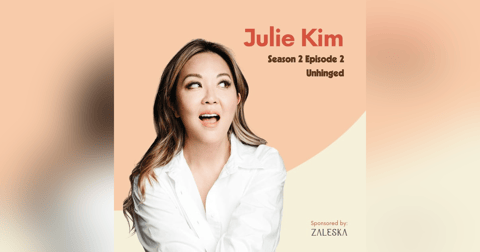
Julie Kim: Unhinged


In this episode of the Half Betty Podcast, Julie Kim, a top Canadian stand-up comedian, writer, and producer, joins Andrea and Krista for an engaging and honest conversation. Julie shares her journey in comedy, motherhood, cultural identity, and the unique challenges women face in the entertainment industry. She talks about her evolving comedic style, fueled by real-life experiences (including the highly annoying ones) and how it helps her connect with diverse audiences. The discussion highlights her impactful storytelling, growth as a comedian, and dedication to breaking barriers in comedy. Julie also shares upcoming plans, including live shows and her podcast 'Bothered.' This episode is filled with laughter, insights, and inspiration for women in comedy, and beyond.
Bio
Julie Kim is one of Canada’s top stand-up comedians. Julie recently toured across North America doing 40 theatre shows with Ronny Chieng (Crazy Rich Asians, The Daily Show with Trevor Noah). She was a gala performer at the 2022 Just for Laughs Festival in Montreal and headlined four sold-out solo shows at Just for Laughs Toronto in 2023. Over the past decade, Julie has performed at all the major Canadian comedy festivals, including Just for Laughs Vancouver, Winnipeg Comedy Festival, and Halifax Comedy Festival (with multiple televised performances). She tours internationally and made her debut at the 2023 Melbourne International Comedy Festival. Julie has also been regularly featured on CBC’s The Debaters.
In 2023 Julie also debuted at both the Toronto Fringe Festival and Victoria Fringe Festival with her solo storytelling show called No One Special.
Julie is also a Canadian Screen Award-winning writer and producer. Julie has contributed to the writing rooms of Kim’s Convenience, Run the Burbs, and Still Standing. She has been part of the writing and creative consulting team at the Winnipeg Comedy Festival for the past three years. She was also a writer for Just for Laughs Montreal in 2022. Julie was a producer and writer for Simu Liu (Marvel’s Shang-Chi and the Legend of the Ten Rings) as he hosted the 2022 and 2023 Juno Awards. She ideated Liu’s now well-known ‘I am Canadian’ monologue, which has gone viral on the Internet and social media.
Additionally, in 2023, Julie was included on VIBE’s list of POWER 60: Inspiring Asian-Canadians of Influence. Other notable honorees included Lilly Singh, Andrew Phung, and Russell Peters.
Julie's mission is to spread happiness, lighten hearts, and unite through laughter. And no amount of ‘mom-shaming’ will stop her in this quest.
Julie’s Five+ Words - food-loving (and also resentful), analytical, unhinged, random, adventurer
References
Link HERE to March 8th Women’s Day Event at The Biltmore.
Andrea and Krista will be in attendance! Come meet us and say hello!
Sponsor Information
Zaleska size-inclusive jewelry
Enter code HALFBETTY for 20% off your first purchase
Connect with us
Website link here
Instagram link here
LinkedIn link here
Facebook link here
Leave a voicemail for us
https://www.halfbetty.com/voicemail/
Founder/Host: Andrea Rathborne
Creative Producer/Co-Host: Krista Gruen
Editors: Andrea Rathborne & Krista Gruen
Audio Engineer: Ryan Clarke
Episode sponsors: Zaleska size-inclusive jewelry
Julie Kim - S2 Ep2
[00:00:00]
Krista: Welcome to season two of the Half Betty Podcast. Whether she's at home, on the road, or on stage, our next guest has a rare gift of finding humor in everyday life, especially the moments that come with midlife, juggling it all, traveling nonstop. Being a mom and laughing her way through the chaos. She connects through audiences, through sharing her perspective as a woman of color, a mother, and always with honesty, heart and sharp comedic edge.
She's a writer, podcaster, speaker, one of Canada's top standup comedians, and a Canadian screen award-winning writer and producer. She has toured internationally and performed at Just For Laughs and other major comedic festivals. Our guest has written for shows like Kim's Convenience and Run The Burbs.
Her mission is simple and powerful to spread happiness, lighten hearts bring people together through laughter. And honestly, that's exactly what we're experiencing today. So please welcome Julie Kim to the Half Betty Podcast. [00:01:00] Hi Julie.
Julie: Is that weird that I clapped for myself? I'm clapping for us being here. Thank you so much. What a, what a nice intro. It's really nice to be here.
Krista: I just love your comedy in the way that you are very realistic and you just take everyday things and to make them funny and bring them to our attention,
'cause I
we all wanna relate to each other, We just wanna feel seen.
Julie: I appreciate it. I got to get acquainted with your podcast. and I listened to the whole last episode while I wasdriving. Uh, and I found that really enjoyable and a few other ones too. So I'm a fan also. Mm-hmm. Of course,
Krista: Oh thank you so much. That's really kind of you to take the time to do that. Yeah, I know we don't always have the time, so,
I'm so happy you're here. we love to start with asking our guests five words to describe themselves. And it could be really anything. It could be positive, it could be something that you're working on. but whenever you're feeling in the moment, that helps our listeners figure out who you are and where you're coming from.
And this is not a test.[00:02:00]
Julie: It's not a test, but I do feel pressure. I mean, not in a bad way. Oh, this is such a simple question, but what do I say? Um, okay. Some of these might not be real words. Uh, one, one thing I'm grappling with right now is the fact that, like, as a woman, I don't, and by the way, I won't explain all of them, but I, I love food and I love taking care of my husband and daughter and making sure they eat well.
So I'm food loving. It's part of me, my upbringing, uh, cultural background and my responsibility, uh, sort that I take on as a, a wife and mother. But then I also hate being the one who does the cooking and the mental load around, the groceries and stuff. Um, so, so I am food loving, but also resentful.
So that's a little phrase. I guess as a continuation of that train of thought, I would say analytical. I'm always thinking of things and overthinking, um, because I think what works for comedy. But also I love thinking, I love, my brain. I love doing things with it and [00:03:00] words and things like that.
So I would say that's how I define myself. Um, I am, um. Increasingly kind of unhinged. Uh, and I don't mean that in a, like, oh, I'm such a hot mess way, like as a humble brag or whatever. But I do feel like I, I lack boundaries and, uh, uh, a ceiling for my emotions and my words, and I swear and awful lot.
I just often feel a very large range of emotions, including rage, which I allow myself to feel a lot of, but then also so many daily moments of bliss and just like being happy to be alive and be here and be grateful for everything. Also, um, fourth word, uh, rather random as you can tell, from, uh, everything I've been saying, just like my likes and my tastes and what I think about and talk about are fairly random.
And the fifth word to describe myself as is. [00:04:00] Uh, I guess adventurer. I love adventures and it's not that like I could be seen climbing Everest. In fact, I'll probably never do that or bungee jump, but I feel like, I think of adventures as like a mental and emotional. So I just love trying and doing new things or learning things or just going out on a walk with my family or friends and, um, seeking like, you know, adventure for various, uh, senses, even new foods or cultures or learning about something via a book or whatever.
How do I do? Is that five?
Krista: You did great. That's amazing. Like I said, it's not a test. you didn't, um, you didn't say funny.
Julie: Oh, I think that's just a given. I feel like you, can I tell you what else? I think about this often because I think about the things that I need in life to be funny and like in a state of funny for writing my material and performing and I need to be [00:05:00] happy and fulfilled in order to have that, do you know what I mean?
And so, so I think being funny is just like it's a natural characteristic in me and it's something that comes out best when I am activated and I am activated when I fulfilled, I guess the things that comprise the five things. This is not a formal framework.
Okay. I haven't thought about it before, but I guess that's why I didn't mention funny. And also how lame is it to be a comedian and say one of my top five traits that I'm funny.
Krista: Okay. Fair.
Julie: I guess, I guess
What are we talking about now?
Krista: so
Andrea: what I'm finding now in reflection on the guests that we've had last year is that it's really an honor to get to meet people that perhaps I hadn't known before
Because what I'm recognizing is that it's sometimes outside of the [00:06:00] people that we are attracted to or drawn to, we find these amazing spirits and connections that we're like, oh, I would've had no idea that I had that kind of experience with that person. And the reason that I mentioned that is, and this Krista will maybe giggle a little bit, but I Maybe you will too.
I hope you will. I, I have always had a little bit of like a block with, uh, comedy.
Krista: God, I always forget. I'm so sorry. I always forget.
Andrea: No, no, no, no, no, no, no.
Julie: Like what? What kind of block?
Andrea: So I, okay, so, I'm gonna explain this in my very neurodivergent way. I,
Julie: Cool. Love it.
Andrea: I, I do love humor, but I think that I, I lean more towards a, a dark humor or a,
Krista: But also scripted
Julie: Oh, oh, [00:07:00] like,
Andrea: Nope.
No. Not necessarily scripted. No, no.
Krista: 'cause I thought that's where the safety lies for you.
Andrea: well, no, I, like candid, honest, raw, real humor that is not on the nose and, and is. understated in a certain way and delivered in a way whereby not maybe everybody would get it. So I think my experience early in my, um, twenties was that for a very short time dated, a standup comedian
Julie: Go on.
Andrea: uh, who had two other comedians that he was friends with, that we would hang out and I would go to some of the shows and I ended up going to one of the shows of this fellow that I was dating and he ended up [00:08:00] using.
My likeness in some of the comedy.
Julie: Mm-hmm.
Andrea: And it wasn't good humor. It was in poor taste and weird.
Julie: Yes.
Andrea: And I was like, Ew. One, two. I found that he and these other fellows, as much as they were funny and, and he wasn't really so much, but the other ones were actually better. Um, but
They were never not on.
Julie: Uh, yeah. That's exhausting sometimes
Krista: Yeah,
Andrea: And it was so exhausting. And I was like, oh gosh.
Julie: always doing a bit.
Krista: Hmm. Testing, right? Yeah.
Andrea: I started to go to comedy shows all the time because of this time and space. And I was going to, obviously the wrong shows because so many of the ones that I was going to there was, uh, either the comedian was heckled by the crowd, which [00:09:00] made me really uncomfortable for comedian
Julie: Oh, are you a big empath?
Andrea: so big.
And I wanted to jump in and protect the comedian. And then conversely, if it flipped and the comedian was, heckling the crowd, I was like, oh my gosh, no, no, no. Don't, don't do that. So I ended up feeling so incredibly uncomfortable.
Julie: And you can't just enjoy the show.
Andrea: Exactly. And so I was
Julie: like you're a character in it. Like you have a responsibility. That's so funny. I've known people like that before. I had a friend come to a show and uh, it was so weird 'cause it was just like an open mic. I mean, none of us did really, really well. It was like maybe 10 years ago or whatever.
And when she was leaving she's like, I could not enjoy the show. I was just too nervous for all of you. And I was like, you should never be in the audience. Like, just 'cause she not you.
Andrea: it's true. Yeah.
Julie: you, she could not switch her role and just view it as entertainment. And [00:10:00] maybe it's different if it's on TV versus like
Andrea: Maybe, maybe
Julie: at the pub whatever.
I mean, do you feel that when you watch a movie or a show?
Andrea: but here's the thing. There's been breakthrough in midlife.
Julie: wow.
Andrea: So when Krista and I went to,the Reese Witherspoon's, conference down in LA um, that we have been to twice now. And the first year that we were there was right when we were launching Half Betty.
Julie: Oh, nice.
Andrea: as Krista and I were sitting, we happened to get like front row seats at the opening of this conference with Reese and all of her different people that she's got. And we were like, oh my gosh, this is amazing. But what they did was that they opened the whole, the whole series of conference speakers with a standup comedian.
Julie: Oh, who was it? Do you remember?
Krista: Heather McMahan
Julie: Oh, okay. Okay. Great.
Andrea: so Heather McMahan walks out on stage and Krista looks at me from a side eye 'cause she knows that [00:11:00] this is my biggest discomfort zone and now I'm in the front row.
Julie: that's like being like, oh no, there's peanuts here. If you're like you're allergic or something
Andrea: Exactly.
Julie: she knows your triggers.
Andrea: Yeah. And my and my like neck started to crawl with like red and I was just like, oh my gosh.
Julie: anaphylactic shock.
Andrea: Like the peanuts, like just like it was peanuts. Like Heather McMahan was a bag of peanuts.
Julie: Oh my God. And she's a very, she's a very irreverent, loud, like she's in your face,
Krista: Yeah,
Andrea: well guess what?
Julie: What?
Andrea: I did not make eye contact. I was looking anywhere but possibly her. And guess who she singled out in the front row?
Julie: Of course. In the front row!
Andrea: Right?
Krista: of course.
Julie: course, because it looks to the comedian on stage like, you are having a bad time, or you don't like us and we need you to like us. So whatever went through her head. So what did she say to you?
Andrea: Well, she said. Something about. [00:12:00] Krista. I, I've probably blocked it out,
Krista: You probably blacked out. Yeah.
Andrea: here's the spoiler. Spoiler alert. Spoiler alert. It was the most uncomfortable. And then that was why it flipped the script
Julie: Oh,
Andrea: and I was like, oh,
Julie: You broke open. She popped your cherry
Andrea: Yes,
Julie: she know that? Did you address what was happening in the interaction?
Krista: We did after like, so basically she said, um, okay. And so she's like, we're all here, dah, dah, dah. And she's like, and you like, what do you do? and Andrea was like, oh, I, um, I have a podcast. And she's like, cool, what's podcast about? She's like, uh, well, you know, Betty White and I share the same birthday.
And she's like, cool. So you stalked Betty White and you made a podcast about it. That's building a she empire. I love it. That's great. And like, she just kept going, right? but Andrea was like, uh, it was adorable.
Andrea: But it ended up being all at once [00:13:00] the most uncomfortable and also the most, um, again, like kind of breakthrough moment because I, it clicked for me Heather was just like me. She was another woman in her midlife with her story, with what, you know, what lights her up
Um, and there was a reframing that happened in that moment. And I will say that I've not only gone to more comedy since that time, but I follow comedians including yourself, and I have this completely reframed perspective on how. utterly and like profoundly impactful humor can be
Julie: yeah,
Andrea: across all aspects of life.
Julie: That's beautiful, Andrea.
Andrea: so when Krista was like, oh my gosh, okay, so you know that I love Julie. And I was like, yes, I know you [00:14:00] love Julie. And she's like, well, you're never gonna guess. But I think that Julie might consider being with, and I was like, oh my
Julie: Oh my God. Well, I am honoured
Andrea: this is part of the journey.
Julie: This is, this is really an intervention for you, Andrea. We just
Krista: It really is. Yeah. You're welcome.
Julie: Uh, yeah, I Krista told me all about this and she said, can we have a midpoint check-in? Um, no, I'm just
Andrea: I appreciate it. Keep going. I'm a willing participant.
Julie: You're doing great. No.
Andrea: Thank you, Krista, as
Julie: See you later.
Andrea: I'm off. No, just kidding. Krista,
Krista: Love it.
Andrea: It away. I know that was a lot longer than we expected, but you know that that's me.
Julie: Oh, I love it.
Krista: It'll be great.
Julie: your humor comes from experiencing life, right? Yeah.
I think so I used to feel bad about being one of those comedians, especially when you first start out at the open mic scene. There's people who are like popular or really entrenched in the scene and they're buddies with everyone. And when I started like over 10 years ago, [00:15:00] it was very, very male dominated and it was not diverse.
So I actually didn't even have the chance to like be one of the, people there and just part of it or whatever. Um, so I used to feel bad about the fact that, oh, my, my life is about more than comedy. 'cause when I started comedy, I was like doing a grad, I had just started a graduate degree. I was, um, you know, in my early years of like working.
In corporate, on Bay Street in Toronto. And it felt always made me feel like not really being a comedian to like, you know, oh, this isn't my whole life and I'm not, um, you know, maybe doing it enough or not legit. But actually in the longer term it has ended up being a huge asset to view comedy as work and also a thing that I really, really love and having a full other life because the people that are gonna relate to you online and come pay to see you in a theater and have the time to digest you [00:16:00] as entertainment are regular people who have jobs who go to school or went to school or have a family and all that kind of stuff.
So I would say that that's ended up being, um, really nice actually. Yeah. Relatability.
Krista: so great. Yeah, yeah, yeah. It's so, it's so important.
And so this style of comedy with your relatability, has that always been a thing or did that switch a little bit later on in life? Like, did it change when you started taking it more seriously and like really committing to this as a job? Or at what point did that switch over?
We're always curious about catalysts and you know, when, when people switch paths and what happens and what causes those moments.
Julie: Yeah. I'll say that from the start, I have viewed, uh. Everything as capable of changing, whether it's like my job or me or whatever. Like I remember like my parents had a convenience store and we grew up on living on top of that convenience store, so there was no delineation of work and [00:17:00] life. It was all just mushed in there.
A little bit messy, but also like, you know, they had a small business and it is categorically, you know, entrepreneurial and there are ups and downs and there's no stability, there's no job stability, there's no, um, like union, there's no giant pension or
Andrea: Mm-hmm.
Julie: anything, which makes it of course, stressful, but also means that I grew up with not really any entitlement of, you know, my boss has to do this for me.
The government needs to do this. Like, it's entirely incumbent on me to make a living and to make it work. And there's like no one else to blame either. And then like when, when I got out of undergrad, I started working in consulting, which itself is very, um, uh, uh, diverse and kind in terms of the things you do and your clients and the things that you can learn and output and stuff like that.
And then I did school as I worked, [00:18:00] and I, like I always did that. I always did a combination of things, so I never thought that anything ever needed to be stagnant. But I also always sort of advocated for myself or maybe in a little bit in the beginning, outta fear. I don't wanna be pigeonholed, I don't want other people telling me who I am.
And sometimes that comes from, I think like growing up as an Asian kid or one of the only Asian kids in the neighborhood we lived in. And anytime someone tried to tell me who I was 'cause I was Asian, whether it was like a kid teasing or even an adult. I remember one time as a child walking into like an art store that pop art supply store that popped up where we lived.
And I walked in and there was this old German man and I was buying Conte or whatever, charcoal, and he said, are you one of those Chinese girls who does really well in school? And I remember just being taken aback. 'cause it's not a bad thing to be,
Krista: How old were you?
Julie: that you're, I [00:19:00] think I was a child, like it was like 10 years old and he just. I don't think I was like offended necessarily, but it was, uh, more like I really, really needed to process the fact that somebody just based on like what I looked at, assumed that I was one, a certain race that I was not. But secondly, like something be like knowing nothing else about me, right? And I, I had a real disdain from that, from the start.
You know, I would even be like, oh no, I'm really stupid. Uh, I'm Asian, but I'm really stupid and we exist too. You know, things like that. So I never liked the idea of anybody ever defining me. So being pigeonholed was always a fear for me. So I was always like trying to, you know, spread the boundaries of what I did, whether it was like go to school for, you know, various things or try this job or that job.
Like when I was working in, uh, Toronto, I was like also doing martial arts. And then at one point when I got my black belt, some of the other guys were like being bouncers and nightclubs, and I was working in corporate in a, like [00:20:00] a respectable thing. But I was like, oh, I wanna try that too. And maybe that's like an adventurous kind of trait in a bit.
Like I wanted to know how other people lived and I wanted to see life through a different perspective. And I thought it would be really cool to do, but it ended up not being cool because they just made me like, go follow the girls who were throwing up in the bathrooms at the clubs. Like I wasn't like allowed to fight or whatever.
And really that's what I wanted to do, but. Anyways. Um, when I started comedy, I didn't think it was something that I was able to do as a career. Like, you know, the arts weren't pushed to me as a child growing up. And you'll hear a lot of people say that, especially if they're from immigrant families. 'cause we're often pushed into traditional, maybe respectable, but like, you know, kind of non-risky things because we don't have things to fall back on, like a giant pension or a huge inheritance.
So. some kids of immigrants will say that is a bad thing. I think it's a great thing because like as an adult now with [00:21:00] bills and stuff, it is not good to have not money. And I think that also as a woman, money is freedom and security and it allows you to, have a foundation from which you can do other things and have this feeling of abundance.
Um, so I don't think that's entirely, wrong at all, but it was not in the realm of possibility, like in the paradigm that I, was raised with that I could be an artist. And even in school they teach you that you're either something like technical or conventional or you are an artist.
Um, so it was just not something that I thought I would do. So I actually started comedy as a fun thing to try. Um, because I thought I was funny. That's why a lot of people start, 'cause someone said they're funny So I thought I would try it as like this bucket list thing.
And I didn't ever intend to keep going but I just didn't stop. And so that's what happened. I just didn't stop. And then. After a number of years, and [00:22:00] I'm talking about like almost 10 years, I started doing it more. And I started getting inspiration in a few places, I started to see stories of more artists that came from conventional backgrounds.
'cause I hadn't really heard of that before. I had only heard of comics who, after high school they decide to be a comic and then they would just like, go on. You know what I mean? I think that's one really nice thing about social media and people sharing their stories because it makes you believe that you could do it too.
And, it doesn't matter how I started out or what my education was or what I used to be, I can turn into anything that I want. But the challenge was to do it in a way that, wouldn't leave me homeless, or, unable to eat or buy things or whatever. So what I did, based on the inspiration of two women. Actually, one of them is, Liz Gilbert of Eat, pray, love, and she's got this book called Big Magic and it's all about creativity And I just remember this one part. I mean,overall it was a [00:23:00] great book and I loved how she talks about creativity and being this entity that you have to feed or have an affair with.
Like, it's so
Krista: Yeah.
Julie: But her story of her being someone who didn't quit her day job even after the massive success Maybe it was her second or third book was so validating for me, right? Because people like to say, oh, you're not an artist until you do this, or unless it's the only thing you do, or, most of what you do or most of your income comes from it.
But here's this massively successful author taking kind of the same route. and there was another comedian named, Aisha Tyler.
Krista: Yeah.
Julie: Yeah. From the Improv show and somewhere in some podcast or something, she talked about the fact that she kept a day job for a very, very long time too, because she needed to pay her bills and not be a super starving artist or whatever.
So those were two examples in my comedy midlife, right? when I was like. Partway through it, that [00:24:00] gave me sort of this idea that I could also build a bridge. And that's kind of what I did. I did more of the conventional things until I was doing well enough in comedy that I started to
Let go of the other stuff and then reach the other side of the bridge. Um, so that's it in simplistic, terms. But even as a comic, I'm continuing to experiment and have adventures, Like starting to write more for TV and film. Being a comedian is so multidimensional now like, you can't just be a comic.
Uh, you have to be a content creator too, unless you're like super famous But I see it actually as a wonderful opportunity to bypass a fairly strict, decision maker framework that used to, exist. Before you had to be like undeniably funny for them to book you or represent you and stuff.
And now, the undeniable is, are there people who care about what you have to say and will subscribe to you and follow you or get a ticket to see you? And that is so [00:25:00] largely in my own hands that yeah, it's a big responsibility. It's a more broadened scope, uh, in terms of what this job is.
But it's so amazing to be able to have so much control over it. Also. Did that answer your question at all? Where did we start? I'm so sorry. Remember I said I'm random?
Krista: Yeah. No, not, not. Yes you did.
did. And you covered and you went so much deeper than I had anticipated. I'm so glad becauseyou are a storyteller. You are a storyteller from your very heart. And the fact that you could go back and explain how you got to here because everyone wants to know that,
these podcasts and these stories we've kind of focus on the now and it's really interesting because that colors who you are, like your parents, you're living on top of a convenience store going through your life when you were younger, being in a corporate world, transferring into comedy 'cause someone said you were funny, giving it a go and realizing all of a sudden that okay, yeah, I am funny and I don't need to put that in my [00:26:00] five descriptive words
Julie: That's right. That's right.
Krista: like. Be funny 'cause I am, um, I had a couple things. One I'm curious if you have had anyone approach you with that feeling of like, wow, I look up to you. Maybe not like a mentor, but maybe, or someone who's come up to you and been like, you have influenced me to the point where I'm trying comedy now.
'cause I see myself in you.
Julie: Oh, that's so nice. I
Krista: Has that happened Or, and I say yet because if it hasn't, I feel like it will.
Julie: oh, I appreciate that. I mean, I, uh hmm. I've had audience members come up to me like in the States, it actually, it happens a lot where, like in Asian person, whether they're younger or older, or come up to me and be like, I'm just so glad that you're here. I love to support you because there are not a lot of women in comedy and certainly not a lot of Asian, women in comedy or women of color in comedy.
so I'll answer your question of if anybody looks up to me, I, I don't know. I [00:27:00] think that would make me feel sort of, weird and uncomfortable.
I tell you why. I feel like I'm someone who hasn't, arrived somewhere. Like there's a constant hustle and I feel a constant survival mode because of the way this industry works. There's always more to do. And I don't mean it from a point of like scarcity or um, sadness or anything like that.
I think, my engine runs like this, so it works well for me. Like I love when there's something to do. I love when there's more to do, um, for sure. But I don't feel like I'm at this pinnacle of a point where it makes sense for someone to say, Hey, I wanna be like just like you or whatever.
'cause I still have my aspirations of being just like many, more successful people. And also it's such a moving target because however good I think I am at comedy now, if I'm. Continuing at it, I am necessarily gonna be better at it next year or in five years, or in 10 years. So I don't even [00:28:00] feel like, oh, I gotta do this all before a certain point, before a wave ends.
Although I feel that, um, with social media, because the nature of social media will change and the devices we are on and the things that fed and AI maybe competing as writers and entertaining will change. But that only. Um, it reinforces, what I said before about needing to always be like on and engaged and things like that, but I find it at this point exciting.
So there are definitely more female comics and, comics of diverse backgrounds, um, starting out, uh, definitely here in Vancouver and everywhere, and I think that's such a beautiful thing. I would not attribute that to me, but to comics who have more massive success like Margaret Cho and Ali Wong
But I also think it could also be because, uh, comedy. is so much more accessible now, right?
Krista: Yes.
Andrea: Mm-hmm.
Julie: and, [00:29:00] streaming and, social media like all the time. I think there's a lot of people who have been introduced to standup comedy through TikTok and Instagram.
Andrea: Yeah.
Julie: but, I, I have, felt the, admiration sometimes of newer comics and newer female comics and I think that's really nice.
But I also feel like things can shift at any time someone who starts comedy brand new, like this year could go viral and totally surpass me and become the superstar. Do, do you know what I mean? So that's why I see everybody as like, we're all kind of the same. 'cause it's this very difficult thing and we cannot control where.
You know, the attention finds people or whatever. So that's why it sounds like a humble answer, but it's not really, it's really just, revealing how flexible and un predictable this whole industry can be. Yeah. Yeah,
Andrea: can I ask you, you have a daughter. [00:30:00] You've mentioned is there,
Julie: She called me a bitch yesterday morning
Krista: Awesome.
Julie: because she decided 10 minutes, Mom, I want bangs.
What you want? Bang. I don't know how to do this well.
And whenever I cut hair, I have to take half an hour because I'm not good at it. And you're telling me 10 minutes before you go to school that you want bangs,
So she's freaking out and she's being mean And she said something like, well now I'm gonna be late 'cause my mom won't cut my bangs. And she goes, that bitch. Which is so horrible, and I know she doesn't really mean it, but I also know she learned that word from me.
And so it's very complex.
Andrea: It's very humbling.
Julie: I know. I know.
Krista: that's so
Andrea: So tell me, tell me
Julie: Mm-hmm. Yeah.
Andrea: tell me with this, this little being in your world, tell me how her being in your world has shifted your own experience of [00:31:00] your comedy and of your work.
Julie: Yes, I think I have multiple parts, Okay. So one is, um,when I became pregnant, I was a few years into comedy, so she's like eight and I was like, uh, maybe five years into comedy or six years or something like that. And, uh, when I personally became pregnant, I just became so much more annoyed at people in the world.
Um, like people just come up and ask me random questions or, just make conversation with me. And, I obviously love interacting with people. I love comedy. It's my favorite thing to do. I love a good conversation. I love connecting with new people, but I hate when people, especially men, use women as social crutches or emotional support strangers.
And then I remember we were buying a new car 'cause we had to, we both had two door cars, so we were switching to an SUV and the man at the dealership, shows us the car.
And he walked around to the trunk and he opens it and he [00:32:00] looks at me and he goes, now you will love this because you can fit a stroller in here and all of this stuff. And I said. I'm not pregnant just to fuck with him. I said, I'm not
Krista: a hundred percent.
Julie: He was an old guy and he went so red. And I was like, no, no, no, no, I'm just kidding.
I'm pregnant. I said, but he and I pointed to my husband is taking the parental leave, so why don't you show him? So just like little things like that over and over again, every day pissed me off so much. But I will tell you that I harnessed that, um, rage, I think because it, uh, it was a beautiful fortuitous confluence of having done comedy enough that it was pretty good.
Plus then, going right back into comedy because a lot of people would be like, oh, that's too bad, you're having a kid now 'cause you were starting to do really well or whatever. So.
Andrea: Hmm.
Julie: I made sure that I went back
Not to prove them wrong, but to be like, no, no, no. I can totally do this. And not intentionally, but when [00:33:00] I went back I was tired. I didn't have as much time. So I really kind of cut through the bullshit and I just had to do more with less time, so I became better at writing and performing.
But also on stage, I transformed, um, because I was, more of an unhinged version of myself, and I started to talk about things in my actual life, in my actual voice, which was now. Stronger and more authentic. And now I was relating to audience members And being more accessible and relatable.
'cause I'm now talking about things that a lot of them have experienced. Everyone either has a child or was a child and has a family and things like that. so truly it was a wonderful, um, opening up for me and it made me become a stronger person. Sure. But, you know, definitely a stronger comedian and so it's just been a natural and authentic, growth of being a comedian.
And yeah it came [00:34:00] from, being a mother for sure. And now, I talk about, being a wife and a mother and parenting, with my husband a lot. I also talk about myself and my own thoughts and evolution as a mother andThat's not all I talk about, but it is sufficient to have a very engaged audience.
I love my audience. My followership has grown a lot and I love the people that follow me and come to watch me and I appreciate them so much, but I love that what I'm doing and saying resonates with them. and all I'm doing is speaking my truth. And not being too serious or sanctimonious about it.
And I think that's what some people like, also, especially on socials, there's a lot of curation. There's a lot of people thinking or saying that they're, perfect and everything's perfect. And I hope that we're getting to a point in time where we don't need that anymore. what I'm hearing, messy is great on socials now, and I'm like, that's amazing.
'cause that's all I got, baby.
Krista: [00:35:00] Works. It works.
Julie: I know, but, and the last thing I'll say is why it works for my life and family is life is tough. There are challenges that we experience every day in domestic life and in parenting and all that kind of stuff, I don't know how other people get their release.
Maybe it's through actual therapy or rest and relaxation. But for me I'm really glad to have, somewhere to put my frustrations. Like if my husband does something stupid, like, you know what he did when I was on tour in the fall with, uh, I hope he's not, I hope he is
Krista: Spill. Spill the tea. Come on. You have to.
Julie: I met, I met
Krista: just the three of us. It's fine.
Julie: So I did this amazing tour with Rick Mercer
Krista: Yes. I saw the show in Vancouver. It
Julie: loved it. Oh, you were there. You were
Krista: Oh, yeah.
Julie: Amazing. So where you did like 28 shows across Canada, a lot of them are sold out. Rick Mercer amazing. Sophie Buddle, Mayce Galoni, all amazing comedians and so fun to be with. We're doing a show in Ottawa at one of the most beautiful [00:36:00] venues I've ever seen, the National Arts Center.
My first time we're on stage doing soundcheck and I get a text from my husband and it says, I can't find the pizza cutter.
Krista: Oh, oh no. Oh dear.
Julie: hell? I know.
Just telling you what's up. And I actually took a screenshot of it and I shared it and my story is, hi, I'm about to do a show at the National Art Center in Ottawa. Maybe you could look harder or find a knife. is what I thought. I think that's all I said. And then I left it and he's like, fair enough.
So,
Andrea: And how relatable is
Julie: It's so relatable.
Andrea: It's so relatable.
Julie: I'm so sad that something so dumb is so relatable, but that is the life that we live, I guess. but I can turn it into something which makes me very, very happy. And I'm just like not a fan of bottling it up. And I know you didn't ask this, but I think one of the things that makes me really feel happy and satisfied now is I feel like I'm my [00:37:00] real activated self most of the time, every day in my work, in my everyday life, and.
I feel like that's a luxury that I, I comparatively to jobs that I've had before or places I thought I was going before with my life where I had to like code switch or pretend I was a more refined or smarter or emotionally regulated version of myself. And I don't really have to do that. Um, now, but also as someone who grew up, in a culture where things were repressed, I never talked
Andrea: Hmm.
Julie: my feelings to my parents.
It's just not something that they were raised to do and I don't blame them for it. Um, but you'll find like a lot of people from East Asian cultures and even South Asian cultures and lots of other cultures, like my husband's not Asian, but um, he converted. No, I'm just kidding. Now I'm trying bit sound on you.
But, um, he is, uh, he's, uh.
Andrea: It works.
Julie: Yeah, he is of like an Anglo and European [00:38:00] background, but they're the same too. So I don't wanna say it's only, you know, Asian cultures or whatever, but because we were repressed so much growing up, like I don't even know if I felt my own feelings. I feel like we were told that you have to be stoic and that means that you're strong or don't burden anybody with your problems.
Don't show off by seeming too happy or too excited. And all that does is stifle you. And the other connection I made a few days ago, and I know that many smarter people have made this connection before too, but it baffles me that autoimmune diseases are so much more prevalent in women. And also I say in a non-scientific way.
Um, but holding things in and repressing feelings and emotion, of course lead to being sick in various ways And a lot of times Us women are the ones that have to hold it in, So this is another great case for being unhinged because it probably can literally make you sick and kill you.
So yeah, that's, that's, yeah. Right. So I [00:39:00] feel all need to
Andrea: I feel like you've given unhinged this new definition that is aspirational because
Krista: Oh yeah.
Andrea: unhinged when you've used it, um, in your beautifully candid, open, honest, real way,
feels like complete freedom
Julie: I like that.
Andrea: to be exactly how you are
Julie: Oh, without falling apart
Andrea: and not edit without falling apart. So you're still, you're still slightly hinged, you're
Julie: Yeah. Like a door falling off the wall, but still can work. Yeah,
Andrea: There's like a little thread that kind of is still
Julie: that's right. All you need. Yeah.
Andrea: So I wanna be unhinged. that's my new aspiration.
Julie: That. I love that. Thank you for
Andrea: Get unhinged.
Julie: we all are a lot of the time, right. But we have to act a certain way in certain situations. Like of course, you know, in the group chat or when I meet other parents and stuff, you can't totally let it all out.
Right? Like you have to [00:40:00] hold, hold in your crazy,
Krista: Time release. Yeah.
Julie: Yeah. Yeah. But that's like being in flow with work or being with the right people who accept you and see you. That's when you can really be yourself, I think. And the goal is, uh, for me to be like that as much as possible, it's not always appropriate. Yeah. But
Andrea: it feels like you are encouraged to be exactly that,
Krista: Mm,
Julie: I am.
Andrea: which is so amazing.
Julie: so. Thank you. It feels very freeing and I appreciate it every day because I know what it's like to not have that.
Krista: Mm-hmm. Mm-hmm. Yep.
Andrea: lived in both spaces. Yeah.
Julie: Yeah.
Andrea: How wonderful. How inspiring. You've even my like for comedy and for
Krista: Yay.
Julie: I'm
Andrea: and for women in comedy.
Julie: Oh, there's a lot of great women in comedy and I feel like that's one of the reasons why, I feel like the way women are perceived has changed so much even in the last few years with the shows that we're seeing and the [00:41:00] comedians and the, like when I first started comedy, I was given the instructions of like, okay, don't talk about female parts, because audiences are mostly male and they hate when you do
And don't talk about your culture. Don't do the Asian voice. People hate that. And then this guy will go off on being Irish for his whole career or whatever. So yeah, I feel like we are the ones that set the rules and the more female comedians we have, the more female audience members we have, and we define what comedy is for us and what we want to hear about and can hear about.
So I feel like that's a beautiful thing that's happening. So thanks for joining us, Andrea. I appreciate that.
Andrea: Thank you for having me and for leading this charge.
Julie: We're all in it together.
Andrea: How inspiring.
Krista: Never. Julie, thanks for, thanks for taking time outta your schedule to hang out with us. We really appreciate it. And,
Julie: such a
Andrea: fun,
Julie: feel like we could have gone on for another hour. Maybe a part two
Andrea: at least
Krista: We're, [00:42:00] game. We're here for you absolutely anytime. Um, for those who aren't following you and why, I don't know, um, maybe they're just discovering you and we're gonna gonna give them a little break.
Where can they find you and learn more?
Julie: Well, my website's, JulieKimComedy.com, everything is there. I do have a lot of, Canadian and US shows coming up. I did all the major Canadian cities last year on my own and then also with Rick Mercer. So what I'm doing in Canada, uh, in the next several months is I'm gonna go to some smaller cities.
And this is like partially because I wanna open myself up to demographics and areas that I haven't traditionally thought are my people because for whatever reason, but it really is part of my mission and what I love about comedy to bridge barriers and understand each other and also represent my kind of comedy in places that I would not think to go otherwise.
So I'm gonna go to places like, Vernon, Kamloops, Lethbridge, Banff, also Calgary, and Edmonton. and I'm [00:43:00] gonna go back to a bunch of US cities. Um, the ones in my calendar right now are like Portland, Austin, Minneapolis. And I'm gonna add a lot more for sure.
Um, I'm actually really excited. we're gonna do a live recording of my podcast. So in Vancouver on International Women's Day. I hope you can come. Yeah, it's, it's
Krista: Oh my gosh. We would love to be there. Yes. Let's do it.
Julie: Uh, so it's at the Biltmore in Vancouver on, um, March the 8th
Andrea: great venue.
Julie: And we're gonna kick off season two of my podcast with some special guests.
But it's also more than that gonna be a women's day celebration. There's drinks, there's gonna be giveaways, and things like that. I want everyone to leave with some great, beauty and wellness products, and we're just gonna get a little bit unhinged in a fun, very female forward way.
So I have high hopes for this one.
tickets have been on sale since last week and they're going fast, so you can find them on my website, JulieKimComedy.com I do have a weekly podcast also It's a video and audio podcast, and the episodes are [00:44:00] super, impactful and punchy.
They're between like 10 and 24 minutes to be digestible for busy women who are unhinged. So in every episode, I tell a story about something that's happening, in my life so often it's a microaggression that happened to me and what I did about it, and we talk about it and sometimes tie it into current affairs, um, and news and things like that.
I've gotten a lot of positive feedback on it. We're growing it significantly and having a glow up for season two. So I'm just grateful, uh, to anyone who wants to check it out.
Krista: And it's called Bothered.
Julie: Come get bothered. Come get bothered. Yes.
Krista: It's so
Andrea: So good. So good.
Julie: Thank you so much
Krista: for your time Julie. We so appreciate you. we gotta do this again and we'll definitely be there. We would love to talk more about that event and how maybe we can be a part of it somehow too.
Julie: Okay, let's be in touch for sure.
Krista: Okay, sounds good.
Andrea: Thank you, Julie.
Julie:
Krista: Thanks for joining us today and laughing along with us. Wow. Julie Kim [00:45:00] is on fire and we love her. You can find us on Instagram @halfbetty, as well as YouTube and on LinkedIn. Andrea and I both have our separate personal pages on there where we write and share stories and pictures, and we would love to see you there.
So please reach out anytime and make sure you share this podcast with your friends, and we will see you soon. Thanks for joining.